Showing posts with label Prayer. Show all posts

Wednesday, May 7, 2025

What Do We Bless When We Whisper?

A few months ago, it struck me that the Shema is an odd prayer. It doesn't seem to be addressed to God. It’s statement of faith made to other Jews, not to God. In the Torah, the words are spoken by the sons of Jacob to their father, affirming their commitment to his God. But, while it was originally God-focused, now it feels people-focused: we are declaring our unity and expressing a sense that something binds us together.

Until the other night, though, I hadn’t thought much about the line we say quietly just after Shema: “Blessed be the name of His glorious kingdom for all time.” What exactly are we blessing? Are we blessing Israel, the “kingdom of priests” that we’re commanded to become? Are we God’s kingdom? Or are we joining the angels in their eternal praise of God, HaMakom? (And what is כבוד? In Hebrew, the word is often translated as “glorious” but also suggests weight, substance, or significance...)

I was taught that we whisper these words because they are the words angels chant endlessly around the throne of God—and because the words break the flow between words of Torah, Shema (Deut 6:4) and V’ahavta (Deut 6:5-9). But I’ve begun to wonder: what does it mean to bless the name of God’s kingdom? Is this an act of humility, as if to say, we don’t speak with the voices of angels? Or are we quietly blessing... ourselves?

I've written to the Chabad rabbi in San Marcos and, if he doesn't think I've missed the point entirely, I hope to have some insights that I can share.
UPDATE: He thought I'd missed the point entirely.

Wednesday, October 4, 2017

At least I'm not an abomination

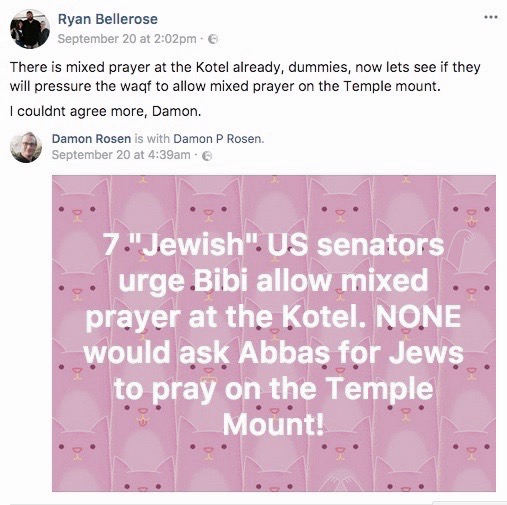
The statement “A woman wearing a tallis and wrapping tefillin is an anathema to Orthodox women” was a response I encountered during a Facebook discussion on Ryan Bellerose's page. It is frustrating to witness Jewish women cursing fellow Jewish women who choose to observe the mitzvot, the commandments of our Torah, particularly when Israel is under serious threat from Christian missionaries and Islamic terrorists.

Living in Israel, I have experienced the unfortunate reality that I cannot freely pray at the Kotel while wearing my tallit, unless I am prepared to risking being spat on or subjected to physical violence.

I struggle to comprehend why Orthodox women feel compelled to dictate whether other Jewish women should wear tallitot or wrap tefillin. Why should the practice of another person or another community interest them?
The Rabbis stated that women are not obligated to observe time-bound mitzvot (with the ironic exceptions of lighting Shabbat candles, immersing in the mikveh, and taking challah, which are all required of women and are definitely time-bound). However, the Rabbis never prohibited women from observing other commandments. In fact, the Talmud even mentions women who observed the mitzvot and it regards such actions positively. The daughters of Rashi, a renowned medieval commentator on the Talmud, wrapped tefillin. Were they considered anathemas? Certainly not!

https://www.facebook.com/ryan.bellerose.338/posts/303358026813526
Ryan has deleted all comments to this pos

Ryan's underlying concern is the prohibition on Jews praying on the Temple Mount, which is indeed a significant issue. However, it is important to acknowledge that we cannot democratically change this reality. In 1967, Israel regained control of Jerusalem, which had been conquered and occupied by Jordan in 1949. As part of a diplomatic resolution, Israel entrusted Jordanian Islamic authorities with control over the Dome of the Rock and the Al-Aqsa mosque. Prayer at the Western Wall, which is located below the Temple Mount, falls within the purview of Israeli democracy.

There is no valid reason for Damon Rosen to falsely claim that everything is perfectly satisfactory at the Kotel nor should he denigrate non-Orthodox Jews by referring to them as 'Jewish-in-quotes.’

Our sages, Chazal, asserted that the destruction of the Temple was a consequence of baseless hatred among Jews, and sadly, such hatred exists today. Damon's words only fuel the fires of animosity.

During the High Holy Days, while I was in the United States, I was free to wear my tallit in public as I prayed as a Jew. It was a personal and meaningful experience that did not harm anyone and felt right. However, living in Israel, I will not be able dance with a Torah scroll on Simchat Torah this year, a holiday that signifies our joy in receiving the Torah. This limitation is due to the influence of right-wing Orthodoxy on practices and norms here.

In all other areas of Israeli life, diversity is accepted and we celebrate our shared heritage. Divisions that affect our spiritual lives are a real anathema.

https://www.ynetnews.com/articles/0,7340,L-4825996,00.html
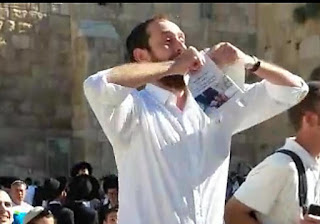
Looking over the mehitza, stealing a siddur, and desecrating it!

Tuesday, March 24, 2015

Prayer, Ritual, and Water for the Birds


Years ago, I interviewed a number of women and asked them about their prayer lives. Each one told me her life's story. 

I wondered why they didn't address my question. Were their prayers too personal to share? Were their experiences indescribable? 

I considered the project a failure, but recently I realized that I'd been presuming to know what prayer is.

Maybe by telling me about their lives, they were telling me about their prayers. Maybe prayer isn't something you do while holding a siddur or while pressing your palms together. Perhaps prayer is more than the words you say to the unknowable. Maybe prayer is how you live and aspire and grow. 

Ritual doesn't need to fit into a mold either. My friend, Mary, and I had only a couple of minutes to plan our Equinox ritual today. There was just a little bit of form to frame our spontaneous celebration-- and our ritual was wonderful.

And also, for me, there's a daily, summer ritual. I'd forgotten about it until last week. I saw the first quail of the year, so I put tin, pie pans in depressions around my yard and filled them with water. Since the rims are at ground level, baby quail will be able to drink from them. 

As in other years, I fill them as soon as I wake up each morning. It's a simple ritual, and not "spiritual," but starting the habit again put me into a different consciousness.

Soon, the hummingbirds will return and I'll put out feeders for them, and for the bees and butterflies.

from pinterest.com