Showing posts with label Judaism. Show all posts
Showing posts with label Judaism. Show all posts
Friday, January 29, 2021
Seductiveness of Prayer and Study
I’m currently studying the teachings of the Piaseczno Rebbi, diving into his unbearable wisdom with Rabbi Lauren Tuchman. It's stunning how Judaism can captivate and enchant me. Here is an unrelated but related video showing overflowing simcha and unwavering emuna at the Lubavitcher Rebbe's farbrengen.

Wednesday, October 4, 2017
At least I'm not an abomination
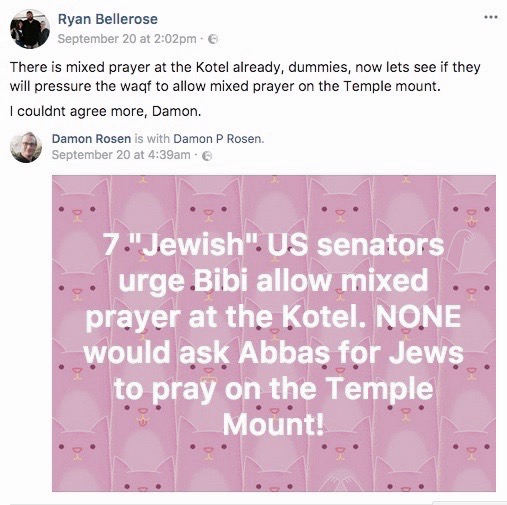
The statement “A woman wearing a tallis and wrapping tefillin is an anathema to Orthodox women” was a response I encountered during a Facebook discussion on Ryan Bellerose's page. It is frustrating to witness Jewish women cursing fellow Jewish women who choose to observe the mitzvot, the commandments of our Torah, particularly when Israel is under serious threat from Christian missionaries and Islamic terrorists.
Living in Israel, I have experienced the unfortunate reality that I cannot freely pray at the Kotel while wearing my tallit, unless I am prepared to risking being spat on or subjected to physical violence.
I struggle to comprehend why Orthodox women feel compelled to dictate whether other Jewish women should wear tallitot or wrap tefillin. Why should the practice of another person or another community interest them?
The Rabbis stated that women are not obligated to observe time-bound mitzvot (with the ironic exceptions of lighting Shabbat candles, immersing in the mikveh, and taking challah, which are all required of women and are definitely time-bound). However, the Rabbis never prohibited women from observing other commandments. In fact, the Talmud even mentions women who observed the mitzvot and it regards such actions positively. The daughters of Rashi, a renowned medieval commentator on the Talmud, wrapped tefillin. Were they considered anathemas? Certainly not!
Ryan's underlying concern is the prohibition on Jews praying on the Temple Mount, which is indeed a significant issue. However, it is important to acknowledge that we cannot democratically change this reality. In 1967, Israel regained control of Jerusalem, which had been conquered and occupied by Jordan in 1949. As part of a diplomatic resolution, Israel entrusted Jordanian Islamic authorities with control over the Dome of the Rock and the Al-Aqsa mosque. Prayer at the Western Wall, which is located below the Temple Mount, falls within the purview of Israeli democracy.
There is no valid reason for Damon Rosen to falsely claim that everything is perfectly satisfactory at the Kotel nor should he denigrate non-Orthodox Jews by referring to them as 'Jewish-in-quotes.’
Our sages, Chazal, asserted that the destruction of the Temple was a consequence of baseless hatred among Jews, and sadly, such hatred exists today. Damon's words only fuel the fires of animosity.
During the High Holy Days, while I was in the United States, I was free to wear my tallit in public as I prayed as a Jew. It was a personal and meaningful experience that did not harm anyone and felt right. However, living in Israel, I will not be able dance with a Torah scroll on Simchat Torah this year, a holiday that signifies our joy in receiving the Torah. This limitation is due to the influence of right-wing Orthodoxy on practices and norms here.
In all other areas of Israeli life, diversity is accepted and we celebrate our shared heritage. Divisions that affect our spiritual lives are a real anathema.
Living in Israel, I have experienced the unfortunate reality that I cannot freely pray at the Kotel while wearing my tallit, unless I am prepared to risking being spat on or subjected to physical violence.
I struggle to comprehend why Orthodox women feel compelled to dictate whether other Jewish women should wear tallitot or wrap tefillin. Why should the practice of another person or another community interest them?
The Rabbis stated that women are not obligated to observe time-bound mitzvot (with the ironic exceptions of lighting Shabbat candles, immersing in the mikveh, and taking challah, which are all required of women and are definitely time-bound). However, the Rabbis never prohibited women from observing other commandments. In fact, the Talmud even mentions women who observed the mitzvot and it regards such actions positively. The daughters of Rashi, a renowned medieval commentator on the Talmud, wrapped tefillin. Were they considered anathemas? Certainly not!
 |
| Ryan has deleted all comments to this pos |
Ryan's underlying concern is the prohibition on Jews praying on the Temple Mount, which is indeed a significant issue. However, it is important to acknowledge that we cannot democratically change this reality. In 1967, Israel regained control of Jerusalem, which had been conquered and occupied by Jordan in 1949. As part of a diplomatic resolution, Israel entrusted Jordanian Islamic authorities with control over the Dome of the Rock and the Al-Aqsa mosque. Prayer at the Western Wall, which is located below the Temple Mount, falls within the purview of Israeli democracy.
There is no valid reason for Damon Rosen to falsely claim that everything is perfectly satisfactory at the Kotel nor should he denigrate non-Orthodox Jews by referring to them as 'Jewish-in-quotes.’
Our sages, Chazal, asserted that the destruction of the Temple was a consequence of baseless hatred among Jews, and sadly, such hatred exists today. Damon's words only fuel the fires of animosity.
During the High Holy Days, while I was in the United States, I was free to wear my tallit in public as I prayed as a Jew. It was a personal and meaningful experience that did not harm anyone and felt right. However, living in Israel, I will not be able dance with a Torah scroll on Simchat Torah this year, a holiday that signifies our joy in receiving the Torah. This limitation is due to the influence of right-wing Orthodoxy on practices and norms here.
In all other areas of Israeli life, diversity is accepted and we celebrate our shared heritage. Divisions that affect our spiritual lives are a real anathema.
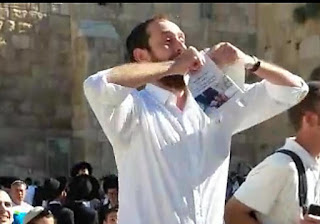 |
| Looking over the mehitza, stealing a siddur, and desecrating it! |
Monday, May 15, 2017
Lag baOmer
This year, Lag baOmer was celebrated for two nights in Jerusalem!
The holiday was "officially" postponed one day so that no one would violate Shabbat to prepare for it, but I smelled bonfires on both motzaei Shabbos and Sunday night. In fact, Sunday night, the air was thick with smoke.
I recently read that Lag BaOmer may have originated in a brief victory of Bar Kochba's troops against the Romans after a series of defeats. That rings true for me. It would mean the holiday is older than Shimon bar Yochai, and attributing it to a later figure reflects the rabbinic inclination to avoid celebrating rebellion or war. Dancing around bonfires for Shimon bar Yochai or the Kabbalistic "splendor within splendor" seem like a later accretion. The Bar Kochba rebellion origin also makes sense of the bows and arrows, symbols associated with the holiday.
Update: According to my employer, the Minister of Education made the announcement postponing Lag Ba'Omer just three weeks ago and it was a vain attempt to control people who don't observe Shabbat; people who are Shomer Shabbat obviously waited until after havdallah to light their fires. Most people had already made plans for the long weekend and didn't change their plans. So the real question, is "Who celebrated Sunday night?"
(Yay! Israeli kids have an extra day off from school!)
The holiday was "officially" postponed one day so that no one would violate Shabbat to prepare for it, but I smelled bonfires on both motzaei Shabbos and Sunday night. In fact, Sunday night, the air was thick with smoke.
I recently read that Lag BaOmer may have originated in a brief victory of Bar Kochba's troops against the Romans after a series of defeats. That rings true for me. It would mean the holiday is older than Shimon bar Yochai, and attributing it to a later figure reflects the rabbinic inclination to avoid celebrating rebellion or war. Dancing around bonfires for Shimon bar Yochai or the Kabbalistic "splendor within splendor" seem like a later accretion. The Bar Kochba rebellion origin also makes sense of the bows and arrows, symbols associated with the holiday.
 |
| Google image |
Update: According to my employer, the Minister of Education made the announcement postponing Lag Ba'Omer just three weeks ago and it was a vain attempt to control people who don't observe Shabbat; people who are Shomer Shabbat obviously waited until after havdallah to light their fires. Most people had already made plans for the long weekend and didn't change their plans. So the real question, is "Who celebrated Sunday night?"
(Yay! Israeli kids have an extra day off from school!)
Sunday, February 26, 2017
Character
I dreamed of Alan and Bonnie last night. Bonnie was explaining to me how Alan cares the way he does.
Many times, I've wished I could apprentice with Alan, learning his skill and compassion in comforting mourners and respecting the departed. However, I've always know that these abilities come from within him and cannot be taught. It's a matter of character and perhaps also of upbringing.
Bonnie's heart and brain work together, too. I know no one else like them and I wish I could be like them.
Saturday, February 18, 2017
No Revelation Without Interpretation
I knew that I couldn't have been the first to notice! And, in fact, not only modern feminists, but also the Rabbis recognized that Moses interpreted God's words and, in doing so, seems to have changed their meaning. (Maybe that's the point.)
Rashi interpreted Moses's instructions as way to ensure that women could be present. Since semen loses its purported ritual impurity after three days, if men stayed away from women, then women could be ritually pure during revelation.
What should we think of Moses changing the words of the divine command?
Judith Plaskow writes,
And HaShem said to Moses, "Go to the people and warn them to stay pure today and tomorrow. Let them wash their clothes. Let them be ready for the third day; for on the third day HaShem will come down, in the sight of all the people, on Mount Sinai. You shall set bounds for the people round about... When the ram's horn sounds a long blast, they may go up on the mountain."The Rabbis wanted to clarify that both men and women were participants in theophany and they interpreted the phrases, "Thus shall you say to the house of Jacob and declare to the children of Israel," to refer respectively to the men and the women."
Moses came down from the mountain to the people and warned the people to stay pure... And he said to the people, "Be ready for the third day: you should not go near a woman."
Rashi interpreted Moses's instructions as way to ensure that women could be present. Since semen loses its purported ritual impurity after three days, if men stayed away from women, then women could be ritually pure during revelation.
What should we think of Moses changing the words of the divine command?
Judith Plaskow writes,
"Several lessons can be drawn from this. One is the inseparability of revelation and interpretation. There is no revelation without interpretation; the foundational experience of revelation also involves a crucial act of interpretation. Second, we learn that the process of interpretation is ongoing. What Moses does, the Rabbis in this case seek to undo. While they reiterate and reinforce the exclusion of women in many contexts, they mitigate it in others. Third, insofar as the task of interpretation is continuing, it now lies with us. If women's absence from Sinai is unthinkable to the Rabbis-- despite the fact that they repeatedly reenact that absence in their own work-- how much more must it be unthinkable to women and men today who function in communities in which women are full Jews? We have the privilege and the burden of recovering the divine words reverberating behind the silences in the text, recreating women's understandings of revelation throughout Jewish history." (The Torah, A Women's Commentary)It's our privilege and responsibility to interpret Torah and we do so within a 4,000 year old tradition.
Tuesday, January 19, 2016
They Say He Erased Her Memory
 |
| Hecht Museum, Israel |
Thanks in part to them, Asherah was not forgotten. She appears in the Bible, the Zohar and other Kabbalistic texts, not to mention the prayer book. She is a weeping mother of Israel, the Sabbath bride, Torah personified, Mother Zion, “His Shekhina,” and a number of other feminine figures in Jewish tradition. As Shekhinah, she went into exile with us and remained with us. The feminine divine survived in our memories, as did our Land.
In exile, our texts helped us remember our connection to the Land.
In the Land there were bamot, high places where we had worshipped our god. At those high places, we had also erected asherot, pillars symbolizing our goddess, "His Asherah."
Opposition to the worship of Asherah grew, particularly in the monarchy. We were supposed to have no king but god, but eventually a monarchy arose and it needed to centralize power and worship. (Read Judges 19 to learn one story that the monarchy created to justify its existence.) It may have been the monarchy’s scribes who wove various traditions into single text, the first four books of Torah, but it was most certainly King Josiah’s scribes who wrote the fifth book, Deuteronomy, as part of his program of religious and political reforms.
These reforms included banning the high places to centralize worship at the Jerusalem Temple. (The northern kingdom with its temples in Beth El and Dan had been destroyed by Josiah’s time.) Nonetheless there were other Jewish temples, and the bamot with their asherot remained places of worship. The prophet Jeremiah reported that men and children continued to gather wood for fire rituals and women continued to “bake cakes for the Queen of Heaven.”
Although King Josiah had the pillar of Asherah removed from the Jerusalem Temple during his reign, an asherah was repeatedly re-installed in and removed from the First Temple during the reigns of different kings. (The seven-branched lamps in both Temples may have been remnants of her worship.)
After the destruction of Jerusalem and the Second Temple, Jews in the Land (renamed “Palestina” by the Romans after the Bar Kokhba Revolt) began putting to paper the oral traditions that interpreted Torah. The study of Torah and the expansion of the no-longer-only-oral tradition preserved us during 2,000 years of the galut (exile). If our religion had remained tied solely to the Land, we could not have survived for so long as a people.
King Josiah, I believe, can take some credit for our survival. And because his reforms focused on eliminating goddess worship among our people, he (inadvertently) preserved her name and even some of her rituals.
Raphael Patai, William Dever, and other scholars have written about the Hebrew Goddess. Rabbi and Priestess Jill Hammer excavates our texts to learn more about our goddess and our resurect our priestess traditions. But in some cases, we don’t have to dig deeply at all. A song, composed in the Land in the 16th century, contains many images of the Hebrew goddess: she is the Sabbath Bride, the city of Jerusalem, the people of Israel, Mother Zion, god’s spouse, and Queen. Each time I hear a congregation sing L’cha Dodi on Friday night, I see her entering the synagogue, clothed in light.
Many faces of the divine feminine are found in our tradition because she accompanied us in our exile, but Asherah herself remained in the Land, among the bamot. Josiah and the Deuteronomists gave us monotheism and a textual tradition that helped us survive exile. But we’re home now and I long to meet Asherah in her Land.
Monday, January 4, 2016
Being Jewish is Not a Competition
Being Jewish is not a competition, and yet so many Jews behave as if it is. In addition to our most prevalent attitudes about death, this competitiveness is the least appealing aspect of Judaism. In fact, it's ugly and vicious.
Once, at a seder, someone began sharing an insight about the giving of Torah. Someone else interrupted and dismissed him by proclaiming that Shavuot, not Pesach, is about the giving of Torah and so Pesach was not the time to discuss the giving of Torah. While the second person was right about the focus of the holidays, redemption and covenant go hand in hand. A potentially good teaching was silenced because of another man's angst and need to draw attention to himself and his supposedly greater knowledge.
Perhaps childish one-upmanship occurs in every religious group, but knowledge is highly valued among Jews, so trying to appear more knowledgeable is always a temptation. Part of our ability to survive among other nations has been our dedication to remaining "separate" and "distinct." So we focus on who is Jewish, who is more Jewish, who is most Jewish, and then naturally, on who we should exclude.
It results in unnecessary divisiveness. Take two different lessons of Chanukah:
We belong to our people and our Land.
To many Orthodox Jews, it is axiomatic that only a person born to a Jewish mother is a Jew. But when you see an adult gleefully telling a young child that he's not Jewish, you have to wonder if that adult has a heart. What benefit does he (or the Jewish people) accrue for making that child cry? Are adults who do that trying to squash their own insecurity?
The angst about "who is a Jew" annuls people's good sense. I knew an observant Jew who worried that she might not be Jewish enough to find a husband because her father was an Orthodox convert—even though her mother had undeniably been a Jew and both parents had raised her as a Jew. Why such insecurity?
Last month, a stranger commented on a photo I posted to Facebook of my chanukiah. "Isn't that lit backwards?" I explained that it had been lit "forwards" and then turned in the window to observe the mitzvah of publicizing the miracle. Many other Jews would have gone on to abuse him for not knowing the laws of Chanukah. It was enough for me to indicate that I wasn't going to be demeaned by him—but why did I need to respond at all?
Because we are a people and each of us wants to belong to our people.
Sometimes it's an Orthodox Jew and sometimes it's a secular Jew, but eventually you'll hear someone go on a tirade about Reform Judaism being inauthentic. Even a man I considered a mensch, and who should have known better, once told me that it was hard to keep himself from giggling when he heard Reform prayers. Reform is a 700 year old tradition of European Jews trying to find a balance between being free citizens of the societies in which they live and retaining their ancestral traditions. Reform Judaism may, in the long course of Jewish history be as ephemeral as the Hellenistic Judaism practiced by Philo of Alexandria, but it is Jewish and its members are Jews.
Meanwhile, every group of Orthodox Jews in Jerusalem believes it is better than all the others.
We are one people. The first time I stood in Ben Gurion, watching the line of "holders of Israeli" passports, my eyes teared up, seeing faces from every part of the world. Despite centuries of separation, we are, ideally, one people.
None of us can be a Jew alone. While each of us prefers our own small group of Jews, it took all of us to defeat the Greeks, all of us to create the modern state of Israel.
Today, I unintentionally triggered someone's Jewish insecurity. When he responded angrily, I was triggered, too, but avoided trying to one-up him with by pointing out that Jews did, in the past, convert people forcibly (see Idumeans and King Herod) because it was beside the point. His frustration was still so great that he posted, "You are obviously not a Jew."
I cried.
I am certain he knew that his statement would hurt me. And I am certain that it made him feel good about himself.
We are one people. And often, we are really nasty to each other.
Sir, may you have a year of blessings. You are my fellow Jew.
Once, at a seder, someone began sharing an insight about the giving of Torah. Someone else interrupted and dismissed him by proclaiming that Shavuot, not Pesach, is about the giving of Torah and so Pesach was not the time to discuss the giving of Torah. While the second person was right about the focus of the holidays, redemption and covenant go hand in hand. A potentially good teaching was silenced because of another man's angst and need to draw attention to himself and his supposedly greater knowledge.
Perhaps childish one-upmanship occurs in every religious group, but knowledge is highly valued among Jews, so trying to appear more knowledgeable is always a temptation. Part of our ability to survive among other nations has been our dedication to remaining "separate" and "distinct." So we focus on who is Jewish, who is more Jewish, who is most Jewish, and then naturally, on who we should exclude.
It results in unnecessary divisiveness. Take two different lessons of Chanukah:
- let's not dismiss the assimilated Jews, after all we couldn't have defeated the Greeks without them
- let's not glorify zealots, after all they became the immoral rulers whose thirst for power handed the Land over to Rome and ultimately caused our exile
We belong to our people and our Land.
To many Orthodox Jews, it is axiomatic that only a person born to a Jewish mother is a Jew. But when you see an adult gleefully telling a young child that he's not Jewish, you have to wonder if that adult has a heart. What benefit does he (or the Jewish people) accrue for making that child cry? Are adults who do that trying to squash their own insecurity?
The angst about "who is a Jew" annuls people's good sense. I knew an observant Jew who worried that she might not be Jewish enough to find a husband because her father was an Orthodox convert—even though her mother had undeniably been a Jew and both parents had raised her as a Jew. Why such insecurity?
Last month, a stranger commented on a photo I posted to Facebook of my chanukiah. "Isn't that lit backwards?" I explained that it had been lit "forwards" and then turned in the window to observe the mitzvah of publicizing the miracle. Many other Jews would have gone on to abuse him for not knowing the laws of Chanukah. It was enough for me to indicate that I wasn't going to be demeaned by him—but why did I need to respond at all?
Because we are a people and each of us wants to belong to our people.
Sometimes it's an Orthodox Jew and sometimes it's a secular Jew, but eventually you'll hear someone go on a tirade about Reform Judaism being inauthentic. Even a man I considered a mensch, and who should have known better, once told me that it was hard to keep himself from giggling when he heard Reform prayers. Reform is a 700 year old tradition of European Jews trying to find a balance between being free citizens of the societies in which they live and retaining their ancestral traditions. Reform Judaism may, in the long course of Jewish history be as ephemeral as the Hellenistic Judaism practiced by Philo of Alexandria, but it is Jewish and its members are Jews.
Meanwhile, every group of Orthodox Jews in Jerusalem believes it is better than all the others.
We are one people. The first time I stood in Ben Gurion, watching the line of "holders of Israeli" passports, my eyes teared up, seeing faces from every part of the world. Despite centuries of separation, we are, ideally, one people.
None of us can be a Jew alone. While each of us prefers our own small group of Jews, it took all of us to defeat the Greeks, all of us to create the modern state of Israel.
Today, I unintentionally triggered someone's Jewish insecurity. When he responded angrily, I was triggered, too, but avoided trying to one-up him with by pointing out that Jews did, in the past, convert people forcibly (see Idumeans and King Herod) because it was beside the point. His frustration was still so great that he posted, "You are obviously not a Jew."
I cried.
I am certain he knew that his statement would hurt me. And I am certain that it made him feel good about himself.
We are one people. And often, we are really nasty to each other.
Sir, may you have a year of blessings. You are my fellow Jew.
Tuesday, September 22, 2015
Our Source, our Council
Rehabir's translation of Avinu Malkeinu was posted to RockyMountainHAI.com.
And although it sounds best when a congregation of average voices sings it, Barbara Streisand doesn't do too badly:
Our Source, our Council, listen for our voice
Our Source, our Council, we have missed the mark before you
Our Source, our Council, Let your compassion flow in us and in our children
Our Source, our Council
empty the world of the pestilence,
war and famine that weighs on us
Our Source our Council,
Empty us of all the trouble
And the hostility that surrounds us
Our Source, our Council,
Our Source, our Council,
Write us in, in the book of good life
Our Source, our Council, renew us
Renew us for a year of good changes.
Listen to our call
Understand our acceptance
Hear our voice
Our Source, our Council,
Our Source, our Council,
Renew us for a year of good changes
Our Source, our Council,
Listen to our cry
Understand our call
Hear our voice
Oh hear our cry
Saturday, September 5, 2015
See the soul of the person sitting opposite you
On the second day of Rosh HaShana, we read the Akedah, the binding of Isaac.
One interpretation of this disturbing passage is that Avraham failed the test. God had always encouraged Avraham to argue with him, but after Avraham nearly killed Isaac, God never spoke to him again.
It's a reassuring position, and it's supported by Torah, but the interpretation feels insufficient. Rabbi Kohenet Jill Hammer shares words of Torah that are more substantial as well as beautiful and profound. Before the Akedah, God called Isaac, "Your son, your only son, the one you love." After the Akedah, the messenger did not repeat the third description of Isaac. Listen to her eight minute d'var Torah here: Missing Words from a Hidden God.
Elul, a month of reflection and repentance is nearing its end. The High Holy Days begin the evening of September 12. It's fascinating that the Jewish calendar is both lunar and solar. It feels good that our holidays are in sync with Nature's cycles.
Sept 12 - 28 Elul - New Moon
Sept 13 - 29 Elul - Erev Rosh HaShana
Sept 14 - 1 Tishrei - Rosh HaShana
Sept 15 - 2 Tishrei - second day of Rosh HaShana
Sept 16 - 3 Tishrei - Tzom Gedalia
Sept 19 - 6 Tishrei - Shabbat Shuva
Sept 21 - 8 Tishrei - Moon at first quarter
Sept 22 - 9 Tishrei - Autumn Equinox and Erev Yom Kippur
Sept 23 - 10 Tishrei - Yom Kippur
Sept 25 - 12 Tishrei - the Powwow begins sometime around sunset
Sept 26 - 13 Tishrei - Powwow and Shabbat
Sept 27 - 14 Tishrei - Powwow and Erev Sukkot
Oct 4 - 21 Tishrei - Moon at last quarter and seventh day of Sukkot
Oct 5/6 - 22/23 Tishrei - Simchat Torah
Oct 10 - 27 Tishrei - Shabbat
Oct 12 - 29 Tishrei - New Moon
One interpretation of this disturbing passage is that Avraham failed the test. God had always encouraged Avraham to argue with him, but after Avraham nearly killed Isaac, God never spoke to him again.
It's a reassuring position, and it's supported by Torah, but the interpretation feels insufficient. Rabbi Kohenet Jill Hammer shares words of Torah that are more substantial as well as beautiful and profound. Before the Akedah, God called Isaac, "Your son, your only son, the one you love." After the Akedah, the messenger did not repeat the third description of Isaac. Listen to her eight minute d'var Torah here: Missing Words from a Hidden God.
 |
| L'Shanah Tovah Tikatevu! |
Elul, a month of reflection and repentance is nearing its end. The High Holy Days begin the evening of September 12. It's fascinating that the Jewish calendar is both lunar and solar. It feels good that our holidays are in sync with Nature's cycles.
Sept 12 - 28 Elul - New Moon
Sept 13 - 29 Elul - Erev Rosh HaShana
Sept 14 - 1 Tishrei - Rosh HaShana
Sept 15 - 2 Tishrei - second day of Rosh HaShana
Sept 16 - 3 Tishrei - Tzom Gedalia
Sept 19 - 6 Tishrei - Shabbat Shuva
Sept 21 - 8 Tishrei - Moon at first quarter
Sept 22 - 9 Tishrei - Autumn Equinox and Erev Yom Kippur
Sept 23 - 10 Tishrei - Yom Kippur
Sept 25 - 12 Tishrei - the Powwow begins sometime around sunset
Sept 26 - 13 Tishrei - Powwow and Shabbat
Sept 27 - 14 Tishrei - Powwow and Erev Sukkot
Oct 4 - 21 Tishrei - Moon at last quarter and seventh day of Sukkot
Oct 5/6 - 22/23 Tishrei - Simchat Torah
Oct 10 - 27 Tishrei - Shabbat
Oct 12 - 29 Tishrei - New Moon
Friday, August 28, 2015
What I'm Reading

Today, I started reading The Hebrew Priestess by Rabbi Jill Hammer and Rabbi Taya Shere, published by Ben Yehuda Press.
So far, it's wonderful! I loved The Jewish Book of Days and Sisters at Sinai, and I'm hoping this will be even better.
A thoughtful review would be more useful to readers, but I can't contain my excitement and wait to post! Once I finish reading the book, I'll gather my thoughts and try to write a descriptive review.
Monday, August 24, 2015
Who is an Indian? Who is a Jew?
Wacipi - Powwow
At the beginning of this video, an interviewer asks a man why he and his family go to powwows all summer. "Because they're powwows. I don't see how you guys can live without ever going to powwows."
Yes!
Although I am one of "you guys," I'm certain that I understand what he meant. I look forward to the local powwow all year and spend every minute I can there. (Once, when I got a new job, I immediately scheduled several days off the following autumn... for the High Holy Days and for the Powwow.)
I can't describe how it makes me feel to attend the powwow and have often thought it must feel a hundred times better to the people whose culture it is. The drums, the singing, the families…
There is a woman I know, part Native American, who never attends the local powwow. On one hand, I can't understand how she could miss it! On the other hand, I suspect (but don't know for certain) that I understand all too well. She once told me that to white people, she is Indian, but to Indians she is white.
Among Jews, the issue of who is a Jew has often hurt me just as deeply as she seems to have been hurt. Being Jewish is central to my identity-- and for that reason I shy away from situations in the States where I might be rejected.
It seems to me, that local Indians at this powwow would have no problem with her mixed ancestry (a good number of them are blonde), but I understand that her wound might be too deep for her to risk herself. It makes me sad for both of us.
The High Holy Days always occur within a few days or weeks of the powwow. I attend services with my heart carefully shielded. It opens with each blast of the shofar and then slams shut.
But the drumming and singing at the powwow free me. My heart swells when veterans in fatigues lead the grand entry and the Eagle Staff precedes the American flag. I watch people who know who they are, who have self-respect. And for some reason, I begin to know who I am.
…but only the shofar makes me cry.
(Oh, hell. Just to lighten the mood, see this.)
Tuesday, August 18, 2015
It is very near you
Reworking of 03/09/14 post.
Too many times over the last twelve years, I have failed to heed my intuition. Each time, I followed the path of “good” sense to a bad end.
The Torah reminds us to pay attention to what our souls tell us and to value our own experiences of life and of divine guidance. Often we are afraid to do so.
We should not rely on someone else’s interpretation of his or her experience of life or of the divine. We should embrace our own experience, our own intuition.
Eve relied on Adam’s interpretation of god’s instructions. What if she had sought to hear god’s voice? What if she had listened to her own intuition? How different would her response to the serpent have been?
Adam also drew back from god. By failing to tell god honestly what he had done, he failed to embrace his relationship with god.
We’re not going to get it right when we listen to someone else as Eve did, or when we fail to treat our god as real, as a partner who is in relationship with us, as Adam did. We must not flee; we must embrace our experience of the divine.
Torah shows us that each of us should listen to god’s words, to our soul's speech. Moses wasn’t always a reliable intermediary. When god instructed Moses to talk to the people, he ran down the mountain and spoke to only the men, so an essential part of god’s instruction was lost in “translation.”
The god of Torah does not expect us to believe without evidence; we are expected to believe only what we have experienced. (Yirimyahu 7:9, Dvarim 11:28) And we should respond by inviting and embracing the experience—even if it means changing our minds, throwing out the rules of conventional reality, or modifying our understanding of a promise we have made. If the promise was to god… god will already understand.
Pay attention, because your intuition can guide you to do what is correct for you at this particular moment. Rational thought is a poor guide and so are rules. You must “act for the soul regardless of what this world demands.” (Mallika Sarabhai)
Too many times over the last twelve years, I have failed to heed my intuition. Each time, I followed the path of “good” sense to a bad end.
The Torah reminds us to pay attention to what our souls tell us and to value our own experiences of life and of divine guidance. Often we are afraid to do so.
And Moses called unto all Israel, and said unto them… The LORD our God made a covenant with us in Horeb. The LORD made not this covenant with our fathers, but with us, even us, who are all of us here alive this day. The LORD spoke with you face to face in the mount out of the midst of the fire… And it came to pass, when ye heard the voice out of the midst of the darkness, while the mountain did burn with fire, that ye came near unto me, even all the heads of your tribes, and your elders; and ye said: 'Behold, the LORD our God hath shown us His glory and His greatness, and we have heard His voice out of the midst of the fire; we have seen this day that God doth speak with man, and he liveth. Now therefore why should we die? for this great fire will consume us; if we hear the voice of the LORD our God any more, then we shall die. For who is there of all flesh, that hath heard the voice of the living God speaking out of the midst of the fire, as we have, and lived? Go thou near, and hear all that the LORD our God may say; and thou shalt speak unto us all that the LORD our God may speak unto thee; and we will hear it and do it.' (Devarim 5:1-23)Tradition teaches that each of us, even those who were not yet born and those who would convert millennia later, experienced theophany at Sinai. We heard god’s voice and we lived. Yet we begged not to hear god’s voice again! We asked Moses to be our intermediary. We relinquished our relationship with the divine and our own power.
We should not rely on someone else’s interpretation of his or her experience of life or of the divine. We should embrace our own experience, our own intuition.
Eve relied on Adam’s interpretation of god’s instructions. What if she had sought to hear god’s voice? What if she had listened to her own intuition? How different would her response to the serpent have been?
Adam also drew back from god. By failing to tell god honestly what he had done, he failed to embrace his relationship with god.
We’re not going to get it right when we listen to someone else as Eve did, or when we fail to treat our god as real, as a partner who is in relationship with us, as Adam did. We must not flee; we must embrace our experience of the divine.
Torah shows us that each of us should listen to god’s words, to our soul's speech. Moses wasn’t always a reliable intermediary. When god instructed Moses to talk to the people, he ran down the mountain and spoke to only the men, so an essential part of god’s instruction was lost in “translation.”
And the LORD said unto Moses: 'Go unto the people, and sanctify them today and tomorrow, and let them wash their garments, and be ready against the third day; for the third day the LORD will come down in the sight of all the people upon mount Sinai… And Moses said: 'Be ready against the third day; come not near a woman.' (Sh’mot 19:10-15)God wanted all of us to purify ourselves. Moses heard instructions directed at the males. (If god had been speaking of cooties, it was the women who should have been addressed since, according to the ritual purity laws, men were a source of ritual impurity far more often than women.) Someone else’s interpretation can be wrong. We must try to listen for ourselves. We may misunderstand (as Moses did), but we may get it right. If we do misunderstand it may, at least, be in a way that helps us gain understanding in the long run.
The god of Torah does not expect us to believe without evidence; we are expected to believe only what we have experienced. (Yirimyahu 7:9, Dvarim 11:28) And we should respond by inviting and embracing the experience—even if it means changing our minds, throwing out the rules of conventional reality, or modifying our understanding of a promise we have made. If the promise was to god… god will already understand.
Pay attention, because your intuition can guide you to do what is correct for you at this particular moment. Rational thought is a poor guide and so are rules. You must “act for the soul regardless of what this world demands.” (Mallika Sarabhai)
* * * *
It is not in heaven, that thou shouldest say: 'Who shall go up for us to heaven, and bring it unto us, and make us to hear it, that we may do it?' Neither is it beyond the sea, that thou shouldest say: 'Who shall go over the sea for us, and bring it unto us, and make us to hear it, that we may do it?' It is very nigh unto thee, in thy mouth, and in thy heart, that thou mayest do it. Dvarim 30:14
Tuesday, August 11, 2015
Parashat Eikev
 |
| https://en.wikipedia.org |
Following are some very disjointed thoughts on Parashat Eikev (Deut 7:12 – Deut 11:25) because someday I am going to learn how to read Torah even if I no longer have a community in which to study.
____
I picked the image for this post because it's raining today, and wet footprints are everywhere! Conveniently, the image may also reflect the name of the parasha.
According to the commentary I'm reading, Rashi connected the word Eikev, “as a consequence of,” to a similar word that means "heel." He suggested that we are not to trample the commandments. (I wonder if the noun “heel” shares a root with a Hebrew verb “to follow.” The next word in the text is from the root “to listen,” but perhaps the two words together reflect our promise at Sinai that we would do and then hear.)
Eikev, like much of Sefer Vayikra (Deuteronomy), contains passages that feel problematic.
The writers of Vaykira were an eclectic group of people with a new vision, which included a vehement opposition to idolatry and a desire to make the Jerusalem Temple the only sanctuary. Vaykira was “discovered” (i.e., written) during the 7th century BCE during the reign of King Josiah when those cranky, but often inspiring, prophets were coming to the fore. (Jill Hammer offers a contemporary midrash in her book, Sisters at Sinai, that describes the priests taking the text to the prophetess Hulda for confirmation of its authenticity.)
The commands in Vayikra were not “given” just prior to the supposed conquest. Its authors lived six centuries later than the apparent date of the text. Displeased with the culture around them, they posited that if their ancestors hadn’t been influenced by the Canaanites, then Israel's “flirtations with idolatry and the resultant punishments” would not have occurred. So they put orders in the mouth of Moses that archaeology shows were never carried out, but which we must contemplate and struggle with today.
In Eikev, the problematic nature of god's commands to the people "before" entering the Land, has been compared to "a handbook for the Taliban." Kill the infidels and destroy all beauty.
Explanations (i.e., excuses) seem inadequate. It hardly matters to me that other Near Eastern nations, the Greeks, Romans, Celts, and Germanic tribes had “the custom to dedicate an enemy to the deity, or to ban him, or after a victory to annihilate him."
I’m thankful that the commands were never carried out; it didn’t happen that way, but what are we to make of this text that we revere? (Richard Dawkins cites a disturbing phenomenon regarding these commandments. When text was altered to seemingly describe a situation in China, Israeli school children condemned it. When shown the original text, other Israeli school children made excuses to support it. He does not clarify whether the children were secular or dati, but still...)
Archaeological finds reveal that Canaanites and Hebrews lived together and there is no evidence of warfare between them. Statues of the goddess Asherah have been found in Jewish and Canaanite homes and I’ve heard (but not confirmed) that Jericho's walls are of a much later date than the supposed conquest. In addition, well-known rabbi, David Wolpe, is a vocal proponent of the idea there may have been no escape from Egypt and no invasion of Canaan, and that the Israelites and Canaanites had lived side by side for centuries. (We may never know, even if the “port towns of Pithom and Ramses,” now under water, are found and excavated.)
I’m frustrated by my lack of books and knowledge. What have rabbis said about the “Taliban-like” commandments found in Sefer Vayikra? I am certain there are beautiful commentaries and drashot (drashim?) on other passages in Vayikra, but I don’t know what they are.
I would also like to read traditional and modern commentaries on tests and “chastisements of love” in the Torah. At least one medieval (?) commentator argued that Avraham failed his test—god did not speak with him again after the Akedah (the near sacrifice of Yitzchak).
The promises of blessings for obedience in Eikev are problematic for modern Jews—even traditional Jews whisper this portion of the Birkat HaMazon: “I was young and I’ve also grown old, but I’ve never seen a righteous man forsaken or his children begging for bread.” We just can’t reconcile the reality of our experience with promises such as these.
Rabbi Greenberg, whose descriptions of the holidays in The Jewish Way are pious, writes very differently of Yom HaShoah: during the Holocaust, god withdrew from the world, even further than in the time of Esther and Mordechai. In that chapter, he asserts that God broke the covenant with us and we are no longer bound by it unless we choose to be.
A phrase that has become a common saying may not mean what we think it means. When we use the expression, “by bread alone,” we are emphasizing that we have spiritual needs in addition to material needs. In the context of this parasha, it seems to mean that god can make anything nourishing, by extension, implying humanity’s powerlessness. Blessings are god’s to bestow in any way he chooses and only complete obedience to god can prevent curses.
Perhaps, if this parasha were named after the third word, tishme’un, “you will listen,” the focus would be more on listening and less on obeying, hearing the cries of others’ suffering, hearing god’s voice today instead of reading commandments that are not literally be what god expects of us—which I think Jews have rarely done; we have, I think, generally avoided fundamentalist obedience. Rabbi Berg always said difficult passages can yield the choicest fruit, if we struggle with them.
The Monsoons
 |
| hdcoloringpages.com/tag/arizona-2014-monsoon |
The voice of Thy thunder was in the whirlwind;
the lightnings lighted up the world;
the earth trembled and shook.
In the desert, we remember that rain is a blessing. Weather patterns have changed enough that, in the American Southwest, the monsoon season has become agony. We wait, gazing at the clouds or smears of rain in the distance, wondering when the winds, lightning, and brief, torrential rainfalls will touch us. Where are the storms and the rainbows? Where are the male and female rains?
Yesterday and today have been dark and wonderful! Even well dressed people take off their shoes and splash through water running in the streets. Thunder rolls again and again. People here are happy today. I've been walking outside, listening to the thunder and letting the rain touch my face, lifting my hair so it would touch the back of my neck.
I tried to recall the blessings. (Thank goodness for Google.)
For thunder, the blessing is, "Blessed are You, Eternal One, ruler of the universe, for your strength and power fill the world." Baruch atah adonai eloheinu melech ha'olam shekocho u'g'vurato malei olam.
For lightning (and other natural wonders) we say, "Blessed are You, Eternal One, ruler of the universe, who makes the works of creation." Baruch atah adonai eloheinu melech ha'olam oseh ma'aseh v'reishit.
And the unusually long blessing to be said when seeing a rainbow is "Blessed are You, Eternal One, ruler of the universe, who remembers the covenant, and is faithful to His covenant, and keeps His promise." Baruch atah adonai eloheinu melech ha'olam zocheir ha'brit v'ne'eman bivrito v'kayam b'ma'amaro.
Thursday, July 30, 2015
Roots in Heaven
I stumbled across this beautiful image during a Google search today. It reminds me of a something my rabbi frequently quoted, "Torah is a tree with its roots in heaven and its branches spread upon the Earth."
 |
| from http://fineartamerica.com |
Monday, July 13, 2015
גִיוֹרֶת
Writing this essay was a required part of my aliyah application. At the time, I resisted writing about this experience, let alone revealing so much of myself to strangers. Now, however, I'd like to share it.
In the summer of 1994, I visited my parents in Arizona. The public library there had a book called The Way of Splendor by Edward Hoffman. It was about the Hasidic movement in Eastern Europe during the 18th and 19th centuries and was my introduction to the history and culture of the Jewish people—I’d barely been aware that history existed.
After reading it, I wanted to experience a Shabbat service and hear L’cha Dodi one Friday evening. It was several weeks before I entered a shul. On erev Yom Kippur, I visited Temple Beth El in the San Francisco Bay Area.
Moments after the service began, I knew that I had found my home. The prayers “resonated” with me, and Rabbi Berg’s sermon included Hasidic tales that were hopeful and life affirming.
The first Friday night following Yom Kippur, after erev Shabbat services, Rabbi Berg invited me to attend Saturday morning Torah study.
Each week, during services we read the weekly parasha, but during Saturday morning Torah study before services, we studied the Torah line-by-line at our own pace, savoring each word, each idea. My first Shabbat, we were reading about the crossing of the Reed Sea. (Thankfully, I did not say, “Hey, there’s a typo in your bible-- it’s supposed to be the Red Sea.”)
Everyone had thoughts they shared, literary to scientific, psychological and agricultural, spiritual and occasionally Talmudic. From “Wow! Isn’t that beautiful imagery” (“and the ground under his feet… was like the very sky for purity”) to an agricultural explanation as to why one generally does not eat first fruits. There were about twenty of us who attended every week. We found gems, even when we struggled through Leviticus.
I did not miss even a dozen Torah studies during the seven years I attended Temple Beth El (three years before and four years after my conversion.) I loved that Rabbi Berg was the kind of leader who facilitated our experience of the text rather than telling us what to think. He was—and I'm sure he still is—a leader who encouraged us to experience Judaism, not one who laid down any rules about what the experience should be.
Nothing I’d heard about the so-called “Judeo-Christian” tradition seemed to apply to this joyful, life-affirming, intelligent, spiritual community. I enjoyed the words of the prayers and rejoiced seeing the Torah being carried around the shul. I appreciated seeing couples who seemed to be in love with each other. (One woman had made her husband a tallis from the chuppah she had woven for their wedding and, each week, during the closing song of the service, he would reach over and wrap her in it, too.) I adored the community and the welcoming attitudes of the people there.
During those first few months, attracted to the community and fascinated by its learning, I was repeatedly delighted to discover that Judaism was beautiful, kind, open, and so many other good things. There is always hope and it’s possible to do more than merely survive. Rabbi Berg said that we break a glass (to commemorate the Temple) at weddings because “If you remember your greatest sorrow at the time of your greatest joy, you will remember your greatest joy during the time of your greatest sorrow.”
Immediately after that first Shabbat, I read The Sabbath by Abraham Joshua Heschel. (Can you imagine encountering the concept of Shabbos for the first time? I was amazed!) And then I read voraciously: everything Rabbi Berg mentioned in Torah study, many of the books in the temple library, anything I could find in the local, used book stores. (I was disappointed that I never connected with his favorite author, Philip Roth. I still don’t… perhaps because I am completely lacking in the culture of Yiddishkeit?)
I went to shul every Friday night and Saturday morning. I was reading and learning every day of the week.
I also learned about volunteering. There were always plenty of volunteer opportunities available through Temple Beth El. One was at an AIDS hospice. At first, I would only work in the garden. Later I worked in the kitchen area. Although, I found the idea frightening, I eventually began spending a little time with the residents.
I began lighting Shabbat candles right away and gradually added other practices. Lighting Chanukah candles for the first time felt familiar, as if I’d done it hundreds of times before.
There were courses offered through the Jewish community. Each spring and fall, you could choose two out of about eight classes that would be held at one of the local synagogues. They covered Shabbat, history, Kabbalah, music, holidays, prophets, and other topics. Scholars like Danny Matt would share their knowledge with us.
Rabbi Berg brought scholars and musicians to the shul. He led retreats north of San Francisco. Temple Beth El was a community of people deeply engaged in Jewish life.
Community and listening to other people were major elements of my conversion: hearing how people had grown up Jewish in different areas, learning about the Holocaust from people who had escaped as children, but had lost family who had been sent to Poland or Spain (one man had been a child refugee in China during the war), learning about growing up in a Jewish neighborhood in the United States, how one woman’s mother had responded to a doctor’s orders to feed her daughter bacon.
I didn’t know enough to ask the questions I should have. Why did Reform Jews say “Gut Shabbos” and call the temple a shul? I didn’t have the awareness to ask more about the Shoah and I still don’t understand one friend’s feelings about seemingly innocent words he said, as a small child, to his parents shortly after Krystallnacht.
There were Pesach dinners with Marion Dolgoff’s family and with the families of Frank and Ingrid Jonas, the afternoon Yom Kippur walk I took with Bobbie Freedman each year, and Rosh HaShanah dinners with Bobbie Freedman and her friends, studying The Book of Jonah from a different perspective each Yom Kippur with Rabbi Berg and others between services, Chanukah with Laine and Joel Schipper, conversations with Evelyn Holzman, women’s gatherings, the sukkah at the shul. (My deep regret, years later, when I realized how I had failed to be supportive of Marion Dolgoff.)
Ingrid and Frank became like family to me. Many times, I cried with gratitude, driving home on Friday nights, because of the joy and love I felt with them. And I was able to express my love. Each year, at seder and Thanksgiving dinner, I saw Frank's children, and they began to feel like family, too.
I went to services and Torah study every week for a long time before I seriously considered conversion. Then, I began meeting with Rabbi Berg to ask questions and learn more about a number of topics.
I had taken basic, prayerbook Hebrew and other classes, attended Shabbat and holiday services, and been invited to people’s homes for holidays. Rabbi Berg had me memorize certain passages, for example: Shema/V’ahavta, Kaddish, Ma’ariv Aravim, and Kiddush.
He discussed holidays with me: the significance of Purim and how to approach Yom Kippur. I didn’t truly understand Purim until just a few years ago. Sometimes I think that I am still converting to Judaism. Obviously, there will always be more information to learn, but understanding deepens over time, too.
I had read several books about the Jewish holidays before Rabbi Berg and I began formal study. The Jewish Way by Irving Greenberg (his perspective and Rabbi Berg’s are a little different) and Keeping Passover by Ira Steingroot are still references for me. Rabbi Berg recommended a number of books to help me increase my understanding of the High Holy Days, including Shmuel Yosef Agnon’s Days of Awe.
He wanted me to be familiar with the philosophy and origins of the Reform movement, but also wanted me to be aware of some traditional practices and he recommended the experience of keeping kosher. (Among many other books, I read How to Run a Traditional Jewish Household by Blu Greenberg, Kashrut by Samuel Dresner, Total Immersion by Rivkah Slonim, and The Rise of Reform Judaism by Gunther Plaut.)
In community and Torah study, I had felt the presence of god, but was unable to describe that experience in words. When I mentioned this, Rabbi Berg said words aren’t always necessary; we each have a private image of god, just as we each have a private image of revelation at Sinai.
Rabbi Berg emphasized the importance of people-hood and, having felt the support and love of the community, I began to understand that, too. We discussed, among many other books, Jews, God, and History by Max Dimant. Over the years, he had recommended historical fiction, like The Last of the Just by Andre Schwarz-Bart, as well as books such as Night by Eli Wiesel, Altneuland by Theodor Herzel, and The Origins of Totalitarianism by Hannah Arendt.
My love of Judaism, my appreciation of Torah and community, gave me a new perspective on life in general, and also on my own life. They gave me confidence and hope. Since god gave us Torah, each of us has value.
My childhood had not prepared me for adulthood or the outside world: we had moved about every six months, my mother was unwell, my father was angry. (Later I realized that what looked like rage, was in fact, constant fear.) They didn’t like me to leave the house or have friends, but they didn’t interact with me except when they were angry, at me or at each other. I had trouble speaking, and I was terrified of people. Social skills eluded me; I didn’t even understand them.
My time at Temple Beth El changed me. Like me, the people there enjoyed books and ideas—they weren't bad things!—but I had never met people who listened respectfully to each other (they listened even to me, even when I had nothing really worth saying) and they truly communicated: shared ideas and explored ideas together.
I was welcomed immediately. In many dreams that I had then, Rabbi Berg and his wife, Bonnie, appeared as my parents. On some level, I had found a new family and was experiencing childhood again. I had found a community and, against all probability, they loved me.
I became able to speak and eventually to articulate (sometimes) my thoughts. Several friends, who became b’not mitzvah as adults, insisted I must have the experience. So in 2000, three years after my conversion, I did. I gave a d’var Torah that had no objective value, but what mattered to me was that it really expressed my thoughts and feelings about Ki Tisa and about being Jewish. Being able to understand and express myself for the first time felt like a miraculous gift. It was possible because I was surrounded by the love and support of my community.
One of the most important things I learned from the community and especially from Rabbi Berg cannot be boiled down to something that fits on a syllabus: how to approach death and mourning.
Rabbi Berg's example of serious attention and compassion toward mourners, and the culture he facilitated of attending every funeral and shiva had an impact on me (and my expectations) that I didn't fully recognize then. Many people from the Torah study group and many from the general congregation went to every funeral and every shiva. We cooked. We spent time with the mourners. Rabbi Berg ensured there was a minyan at the home every day.
At first, I cooked to calm my own feelings about death and I spent shivas in the mourners’ kitchens, helping. Gradually, I began interacting with friends and distant relatives of the deceased; to those most affected, I said little beyond “Sorry for your loss.” But I watched how mourners behaved and how people I admired responded to them; I learned things that I remembered later.
Perhaps, of Rabbi Berg's many gifts as a rabbi, his greatest is caring for the bereaved and for their departed, of knowing its importance. I admired his wife because her brain and heart worked together and I guess that’s what Rabbi Berg was able to do, too.
Once, I went with everyone else to attend a funeral that Rabbi Berg led for a man who had not been a member of Temple Beth El. Earlier that day, I had happened to be in the front office briefly while he met the man’s family in his office. I heard him encourage the family's recollections and, even in the brief moment I was there, I recognized the seriousness he gave their words and unspoken feelings. Later, he gave a eulogy that the family clearly found meaningful. I am grateful that I “had” to go to that funeral. The memory reminds me of how I learned the importance of comforting the bereaved; it reminds me of being surrounded by people with love and caring in their hearts, in their minds, and on their lips.
Of all the wonderful things about Judaism, I think that particular mitzvah is one of the most important and I continue to try to learn how to do that with something of the enormous care and attention that I saw Rabbi Berg offer.
There is a book called Jewish Views of the Afterlife by Simcha Paull Raphael. It describes a great number of Jewish beliefs about the afterlife, but it was people who taught me what was important in our response to death: supporting the people who are facing it.
Bill Fein was a Torah study regular who had studied for his conversion with Rabbi Berg. His father had been Jewish, but his mother had raised him in a fundamentalist church in the South; he had wanted to leave and become Jewish since he was very young. His enthusiasm for Judaism had always filled me with joy. (He expressed his enthusiasm in many ways, down to a rodeo-style belt buckle engraved with a Magen David.) Bill Fein was proud to call himself a convert.
Bill was hit by a car while walking to shul during a visit to Scotland. We were all thinking of him and waiting for news of him while his wife flew to Scotland. He died there, far away from his community, but I think if he could have chosen a manner of death, dying on the way to shul would have been okay with him.
Although he and I had not been close, his passing affected me profoundly. We all missed his presence in our community. Conversations people had about his life made me realize how deep my feelings about Judaism were. Evelyn Holzman said that he died happy with his life, his marriage, his child, his work, and happy with being Jewish; a moment later, I realized that I wouldn’t really be alive in any meaningful way unless I made the commitment to become Jewish.
After I told Rabbi Berg that I was ready to begin formal study, he said that he had been a proponent of my conversion for a long time. My formal conversion took place in September 1997. The beit din included people who had become my friends. There was an indescribable moment in the mikvah, and when I emerged from the water, I was a Jew.
At Rosh Hashanah services, a few days after my conversion, someone thanked me for converting. I was dumbfounded. I had converted for me. I have done nothing for the Jewish people except want to belong.
Once I believed that being Jewish meant preserving Torah, but now I think that being Jewish is seeing the world differently than other people do. It’s about actions you take because you share Jewish values. It means caring about the continued existence of the Jewish people. It’s about contributing to and being revitalized by community. And, for me, it’s about going home, to Israel.
 Meyerbeer's Hallelujah
 |
| A certificate of conversion |
In the summer of 1994, I visited my parents in Arizona. The public library there had a book called The Way of Splendor by Edward Hoffman. It was about the Hasidic movement in Eastern Europe during the 18th and 19th centuries and was my introduction to the history and culture of the Jewish people—I’d barely been aware that history existed.
After reading it, I wanted to experience a Shabbat service and hear L’cha Dodi one Friday evening. It was several weeks before I entered a shul. On erev Yom Kippur, I visited Temple Beth El in the San Francisco Bay Area.
Moments after the service began, I knew that I had found my home. The prayers “resonated” with me, and Rabbi Berg’s sermon included Hasidic tales that were hopeful and life affirming.
The first Friday night following Yom Kippur, after erev Shabbat services, Rabbi Berg invited me to attend Saturday morning Torah study.
Each week, during services we read the weekly parasha, but during Saturday morning Torah study before services, we studied the Torah line-by-line at our own pace, savoring each word, each idea. My first Shabbat, we were reading about the crossing of the Reed Sea. (Thankfully, I did not say, “Hey, there’s a typo in your bible-- it’s supposed to be the Red Sea.”)
Everyone had thoughts they shared, literary to scientific, psychological and agricultural, spiritual and occasionally Talmudic. From “Wow! Isn’t that beautiful imagery” (“and the ground under his feet… was like the very sky for purity”) to an agricultural explanation as to why one generally does not eat first fruits. There were about twenty of us who attended every week. We found gems, even when we struggled through Leviticus.
I did not miss even a dozen Torah studies during the seven years I attended Temple Beth El (three years before and four years after my conversion.) I loved that Rabbi Berg was the kind of leader who facilitated our experience of the text rather than telling us what to think. He was—and I'm sure he still is—a leader who encouraged us to experience Judaism, not one who laid down any rules about what the experience should be.
Nothing I’d heard about the so-called “Judeo-Christian” tradition seemed to apply to this joyful, life-affirming, intelligent, spiritual community. I enjoyed the words of the prayers and rejoiced seeing the Torah being carried around the shul. I appreciated seeing couples who seemed to be in love with each other. (One woman had made her husband a tallis from the chuppah she had woven for their wedding and, each week, during the closing song of the service, he would reach over and wrap her in it, too.) I adored the community and the welcoming attitudes of the people there.
During those first few months, attracted to the community and fascinated by its learning, I was repeatedly delighted to discover that Judaism was beautiful, kind, open, and so many other good things. There is always hope and it’s possible to do more than merely survive. Rabbi Berg said that we break a glass (to commemorate the Temple) at weddings because “If you remember your greatest sorrow at the time of your greatest joy, you will remember your greatest joy during the time of your greatest sorrow.”
Immediately after that first Shabbat, I read The Sabbath by Abraham Joshua Heschel. (Can you imagine encountering the concept of Shabbos for the first time? I was amazed!) And then I read voraciously: everything Rabbi Berg mentioned in Torah study, many of the books in the temple library, anything I could find in the local, used book stores. (I was disappointed that I never connected with his favorite author, Philip Roth. I still don’t… perhaps because I am completely lacking in the culture of Yiddishkeit?)
I went to shul every Friday night and Saturday morning. I was reading and learning every day of the week.
I also learned about volunteering. There were always plenty of volunteer opportunities available through Temple Beth El. One was at an AIDS hospice. At first, I would only work in the garden. Later I worked in the kitchen area. Although, I found the idea frightening, I eventually began spending a little time with the residents.
I began lighting Shabbat candles right away and gradually added other practices. Lighting Chanukah candles for the first time felt familiar, as if I’d done it hundreds of times before.
There were courses offered through the Jewish community. Each spring and fall, you could choose two out of about eight classes that would be held at one of the local synagogues. They covered Shabbat, history, Kabbalah, music, holidays, prophets, and other topics. Scholars like Danny Matt would share their knowledge with us.
Rabbi Berg brought scholars and musicians to the shul. He led retreats north of San Francisco. Temple Beth El was a community of people deeply engaged in Jewish life.
Community and listening to other people were major elements of my conversion: hearing how people had grown up Jewish in different areas, learning about the Holocaust from people who had escaped as children, but had lost family who had been sent to Poland or Spain (one man had been a child refugee in China during the war), learning about growing up in a Jewish neighborhood in the United States, how one woman’s mother had responded to a doctor’s orders to feed her daughter bacon.
I didn’t know enough to ask the questions I should have. Why did Reform Jews say “Gut Shabbos” and call the temple a shul? I didn’t have the awareness to ask more about the Shoah and I still don’t understand one friend’s feelings about seemingly innocent words he said, as a small child, to his parents shortly after Krystallnacht.
There were Pesach dinners with Marion Dolgoff’s family and with the families of Frank and Ingrid Jonas, the afternoon Yom Kippur walk I took with Bobbie Freedman each year, and Rosh HaShanah dinners with Bobbie Freedman and her friends, studying The Book of Jonah from a different perspective each Yom Kippur with Rabbi Berg and others between services, Chanukah with Laine and Joel Schipper, conversations with Evelyn Holzman, women’s gatherings, the sukkah at the shul. (My deep regret, years later, when I realized how I had failed to be supportive of Marion Dolgoff.)
Ingrid and Frank became like family to me. Many times, I cried with gratitude, driving home on Friday nights, because of the joy and love I felt with them. And I was able to express my love. Each year, at seder and Thanksgiving dinner, I saw Frank's children, and they began to feel like family, too.
I went to services and Torah study every week for a long time before I seriously considered conversion. Then, I began meeting with Rabbi Berg to ask questions and learn more about a number of topics.
I had taken basic, prayerbook Hebrew and other classes, attended Shabbat and holiday services, and been invited to people’s homes for holidays. Rabbi Berg had me memorize certain passages, for example: Shema/V’ahavta, Kaddish, Ma’ariv Aravim, and Kiddush.
He discussed holidays with me: the significance of Purim and how to approach Yom Kippur. I didn’t truly understand Purim until just a few years ago. Sometimes I think that I am still converting to Judaism. Obviously, there will always be more information to learn, but understanding deepens over time, too.
I had read several books about the Jewish holidays before Rabbi Berg and I began formal study. The Jewish Way by Irving Greenberg (his perspective and Rabbi Berg’s are a little different) and Keeping Passover by Ira Steingroot are still references for me. Rabbi Berg recommended a number of books to help me increase my understanding of the High Holy Days, including Shmuel Yosef Agnon’s Days of Awe.
He wanted me to be familiar with the philosophy and origins of the Reform movement, but also wanted me to be aware of some traditional practices and he recommended the experience of keeping kosher. (Among many other books, I read How to Run a Traditional Jewish Household by Blu Greenberg, Kashrut by Samuel Dresner, Total Immersion by Rivkah Slonim, and The Rise of Reform Judaism by Gunther Plaut.)
In community and Torah study, I had felt the presence of god, but was unable to describe that experience in words. When I mentioned this, Rabbi Berg said words aren’t always necessary; we each have a private image of god, just as we each have a private image of revelation at Sinai.
Rabbi Berg emphasized the importance of people-hood and, having felt the support and love of the community, I began to understand that, too. We discussed, among many other books, Jews, God, and History by Max Dimant. Over the years, he had recommended historical fiction, like The Last of the Just by Andre Schwarz-Bart, as well as books such as Night by Eli Wiesel, Altneuland by Theodor Herzel, and The Origins of Totalitarianism by Hannah Arendt.
My love of Judaism, my appreciation of Torah and community, gave me a new perspective on life in general, and also on my own life. They gave me confidence and hope. Since god gave us Torah, each of us has value.
My childhood had not prepared me for adulthood or the outside world: we had moved about every six months, my mother was unwell, my father was angry. (Later I realized that what looked like rage, was in fact, constant fear.) They didn’t like me to leave the house or have friends, but they didn’t interact with me except when they were angry, at me or at each other. I had trouble speaking, and I was terrified of people. Social skills eluded me; I didn’t even understand them.
My time at Temple Beth El changed me. Like me, the people there enjoyed books and ideas—they weren't bad things!—but I had never met people who listened respectfully to each other (they listened even to me, even when I had nothing really worth saying) and they truly communicated: shared ideas and explored ideas together.
I was welcomed immediately. In many dreams that I had then, Rabbi Berg and his wife, Bonnie, appeared as my parents. On some level, I had found a new family and was experiencing childhood again. I had found a community and, against all probability, they loved me.
I became able to speak and eventually to articulate (sometimes) my thoughts. Several friends, who became b’not mitzvah as adults, insisted I must have the experience. So in 2000, three years after my conversion, I did. I gave a d’var Torah that had no objective value, but what mattered to me was that it really expressed my thoughts and feelings about Ki Tisa and about being Jewish. Being able to understand and express myself for the first time felt like a miraculous gift. It was possible because I was surrounded by the love and support of my community.
One of the most important things I learned from the community and especially from Rabbi Berg cannot be boiled down to something that fits on a syllabus: how to approach death and mourning.
Rabbi Berg's example of serious attention and compassion toward mourners, and the culture he facilitated of attending every funeral and shiva had an impact on me (and my expectations) that I didn't fully recognize then. Many people from the Torah study group and many from the general congregation went to every funeral and every shiva. We cooked. We spent time with the mourners. Rabbi Berg ensured there was a minyan at the home every day.
At first, I cooked to calm my own feelings about death and I spent shivas in the mourners’ kitchens, helping. Gradually, I began interacting with friends and distant relatives of the deceased; to those most affected, I said little beyond “Sorry for your loss.” But I watched how mourners behaved and how people I admired responded to them; I learned things that I remembered later.
Perhaps, of Rabbi Berg's many gifts as a rabbi, his greatest is caring for the bereaved and for their departed, of knowing its importance. I admired his wife because her brain and heart worked together and I guess that’s what Rabbi Berg was able to do, too.
Once, I went with everyone else to attend a funeral that Rabbi Berg led for a man who had not been a member of Temple Beth El. Earlier that day, I had happened to be in the front office briefly while he met the man’s family in his office. I heard him encourage the family's recollections and, even in the brief moment I was there, I recognized the seriousness he gave their words and unspoken feelings. Later, he gave a eulogy that the family clearly found meaningful. I am grateful that I “had” to go to that funeral. The memory reminds me of how I learned the importance of comforting the bereaved; it reminds me of being surrounded by people with love and caring in their hearts, in their minds, and on their lips.
Of all the wonderful things about Judaism, I think that particular mitzvah is one of the most important and I continue to try to learn how to do that with something of the enormous care and attention that I saw Rabbi Berg offer.
There is a book called Jewish Views of the Afterlife by Simcha Paull Raphael. It describes a great number of Jewish beliefs about the afterlife, but it was people who taught me what was important in our response to death: supporting the people who are facing it.
Bill Fein was a Torah study regular who had studied for his conversion with Rabbi Berg. His father had been Jewish, but his mother had raised him in a fundamentalist church in the South; he had wanted to leave and become Jewish since he was very young. His enthusiasm for Judaism had always filled me with joy. (He expressed his enthusiasm in many ways, down to a rodeo-style belt buckle engraved with a Magen David.) Bill Fein was proud to call himself a convert.
Bill was hit by a car while walking to shul during a visit to Scotland. We were all thinking of him and waiting for news of him while his wife flew to Scotland. He died there, far away from his community, but I think if he could have chosen a manner of death, dying on the way to shul would have been okay with him.
Although he and I had not been close, his passing affected me profoundly. We all missed his presence in our community. Conversations people had about his life made me realize how deep my feelings about Judaism were. Evelyn Holzman said that he died happy with his life, his marriage, his child, his work, and happy with being Jewish; a moment later, I realized that I wouldn’t really be alive in any meaningful way unless I made the commitment to become Jewish.
After I told Rabbi Berg that I was ready to begin formal study, he said that he had been a proponent of my conversion for a long time. My formal conversion took place in September 1997. The beit din included people who had become my friends. There was an indescribable moment in the mikvah, and when I emerged from the water, I was a Jew.
At Rosh Hashanah services, a few days after my conversion, someone thanked me for converting. I was dumbfounded. I had converted for me. I have done nothing for the Jewish people except want to belong.
Once I believed that being Jewish meant preserving Torah, but now I think that being Jewish is seeing the world differently than other people do. It’s about actions you take because you share Jewish values. It means caring about the continued existence of the Jewish people. It’s about contributing to and being revitalized by community. And, for me, it’s about going home, to Israel.

Sunday, February 8, 2015
Change is Bad, or What the Heck Happened to Reform Judaism?
Last fall, I attended an erev Shabbat dinner at the local synagogue. I noted that the potluck was not vegetarian (they were serving chicken) but I knew that kosher laws would not be a consideration at a Reform synagogue. After proudly placing my homemade cheesecake on the buffet table, I looked around the room hoping for an opportunity to introduce myself to someone.
A lady approached me and took me aside. She whispered that I’d have to take my cheesecake away because they were serving chicken.
I was mortified: I had brought cheesecake to a fleishig meal! I stuttered that I hadn’t expected a Reform synagogue to serve a kosher meal. She explained that they do so for possible visitors who might keep kosher. (I wondered how many kosher-keeping visitors drive to a Reform temple after sunset on a Friday night, but since this is the only shul in town, it is thoughtful.)
Before I had a chance to move toward the buffet table and remove my unwanted contribution to the meal, another woman swooped toward the covered cheesecake pan and lifted it from the table. She raised it to shoulder height and dramatically announced in a loud voice that carried across the social hall, “I’m going to take this out of here!”
As she hurried out of the social hall, I followed and took the pan from her, irritated that she was handling my food with disgust and that she had made an unnecessary scene instead of allowing the first woman to handle the “situation” discretely. Outside, as I was putting the cheesecake in my car’s trunk, I recalled the chicken breasts and thighs that I’d seen on the buffet table. They were larger and juicier than any the kosher butcher down in the Valley had ever sold to me.
When I reentered the social hall, the second woman grinned at me from under her blonde bob. “I hope you don’t mind,” she minced while swinging her cute skirt around her knees. I asked her where the synagogue purchased its kosher chicken. She laughed theatrically. “Oh, we don’t do that.”
I was speechless. She had embarrassed me for the sake of a traif meal!
At least at an Orthodox shul that actually observes kashrut, they would have known that my refrigerated cheesecake could not transfer its “dairyness” to the tablecloth and over to the chicken-- which would have actually been kosher.
Something has changed in Reform Judaism during the last twenty years. In 1999, a friend, who had been raised in an Orthodox community, left our synagogue because “Reform is getting too Orthodox.”
At the time, I thought she was nuts, but she may have had a point.
The changes were small at first. A little ritual practice here, the study of select Talmudic passages there.
Has it gone too far? To me, it seems that imposing ritual practice on others is not Reform. And being absolute hypocrites is a little too Orthodox.
The early Reformers of the 1700s did not reject the Talmud but they did reject the idea that Talmudic law was binding. They considered observance and non-observance private matters and rarely addressed the subject of kashrut. Reform Judaism was a response to powerlessness and exclusion that Jews had experienced for centuries prior to the Enlightenment. Keeping kosher continued to keep Jews outside of mainstream society and also caused Jews to be helpless outside their own communities.
One Reform educator, in the late 1700s, did discuss kashrut. He focused on what foods the Torah forbade and the separation of meat and milk, but questioned Talmudic slaughter laws which sometimes contradict the Temple sacrifices described in the Torah. (Basically, this Reformer was advocating what is now called "kosher style.") However, since observance of kashrut had already fallen by the wayside for most German Jews, few people gave the subject much thought.
Later, American Classical Reform rejected kashrut altogether in the Pittsburg Platform. The celebration of the first graduation from Hebrew Union College included a meal that is famously referred to as the “Trefa Banquet” because organizers had deliberately chosen to serve shrimp. (This meal was the impetus for the creation of the Conservative Movement by attendees who thought that eating shellfish was going too far.)
The Reform Movement never officially adopted the Pittsburg Platform. The Reform Movement also emphasizes that Judaism has always been an evolving tradition that responds to changing circumstances. So the Pittsburg Platform is no more binding than Talmudic law.
However, my Reform origins taught me that kashrut and other ritual observance are private matters to be observed only when they are personally meaningful. And my personal experience has taught me to listen to my soul, not other people who want to impose their beliefs or practices on me. (i.e., control me).
During the time that I both kept kosher and attended a Reform temple, I had no grievance with my community for not providing kosher food. Community is the most significant aspect of Judaism (and life in general) and having an Orthodox rabbi meddling in our eating habits didn't seem like a positive thing. Kashrut can be divisive. In my experience, it also fosters an "us versus them" mentality.
I kept kosher for seventeen years and it felt authentic and meaningful. It helped me feel Jewish the other six days of the week and made me attentive and "present." I appreciated the idea that not every animal is available for our consumption and that an animal raised for food should have a good life and be slaughtered as painlessly as possible.
Today, however, the idea of separating meat and dairy dishes or washing my cat’s dishes in the bathroom sink feels absurd—meaningless. Kashrut is not the only, or even the best way, to respect life.
My recent experience of a “kosher-style” potluck, has made me pause. What are the core principles of Reform Judaism? Does the observance of “kosher style” violate those principles? Does kosher-style foster community? Does it teach Jewish values?
For the sake of courtesy and being a welcoming community, I wish the temple had included their dietary rules in their potluck advertisement.
A lady approached me and took me aside. She whispered that I’d have to take my cheesecake away because they were serving chicken.
I was mortified: I had brought cheesecake to a fleishig meal! I stuttered that I hadn’t expected a Reform synagogue to serve a kosher meal. She explained that they do so for possible visitors who might keep kosher. (I wondered how many kosher-keeping visitors drive to a Reform temple after sunset on a Friday night, but since this is the only shul in town, it is thoughtful.)
Before I had a chance to move toward the buffet table and remove my unwanted contribution to the meal, another woman swooped toward the covered cheesecake pan and lifted it from the table. She raised it to shoulder height and dramatically announced in a loud voice that carried across the social hall, “I’m going to take this out of here!”
As she hurried out of the social hall, I followed and took the pan from her, irritated that she was handling my food with disgust and that she had made an unnecessary scene instead of allowing the first woman to handle the “situation” discretely. Outside, as I was putting the cheesecake in my car’s trunk, I recalled the chicken breasts and thighs that I’d seen on the buffet table. They were larger and juicier than any the kosher butcher down in the Valley had ever sold to me.
When I reentered the social hall, the second woman grinned at me from under her blonde bob. “I hope you don’t mind,” she minced while swinging her cute skirt around her knees. I asked her where the synagogue purchased its kosher chicken. She laughed theatrically. “Oh, we don’t do that.”
I was speechless. She had embarrassed me for the sake of a traif meal!
At least at an Orthodox shul that actually observes kashrut, they would have known that my refrigerated cheesecake could not transfer its “dairyness” to the tablecloth and over to the chicken-- which would have actually been kosher.
 |
My old Reform shul
|
At the time, I thought she was nuts, but she may have had a point.
The changes were small at first. A little ritual practice here, the study of select Talmudic passages there.
Has it gone too far? To me, it seems that imposing ritual practice on others is not Reform. And being absolute hypocrites is a little too Orthodox.
The early Reformers of the 1700s did not reject the Talmud but they did reject the idea that Talmudic law was binding. They considered observance and non-observance private matters and rarely addressed the subject of kashrut. Reform Judaism was a response to powerlessness and exclusion that Jews had experienced for centuries prior to the Enlightenment. Keeping kosher continued to keep Jews outside of mainstream society and also caused Jews to be helpless outside their own communities.
One Reform educator, in the late 1700s, did discuss kashrut. He focused on what foods the Torah forbade and the separation of meat and milk, but questioned Talmudic slaughter laws which sometimes contradict the Temple sacrifices described in the Torah. (Basically, this Reformer was advocating what is now called "kosher style.") However, since observance of kashrut had already fallen by the wayside for most German Jews, few people gave the subject much thought.
Later, American Classical Reform rejected kashrut altogether in the Pittsburg Platform. The celebration of the first graduation from Hebrew Union College included a meal that is famously referred to as the “Trefa Banquet” because organizers had deliberately chosen to serve shrimp. (This meal was the impetus for the creation of the Conservative Movement by attendees who thought that eating shellfish was going too far.)
The Reform Movement never officially adopted the Pittsburg Platform. The Reform Movement also emphasizes that Judaism has always been an evolving tradition that responds to changing circumstances. So the Pittsburg Platform is no more binding than Talmudic law.
However, my Reform origins taught me that kashrut and other ritual observance are private matters to be observed only when they are personally meaningful. And my personal experience has taught me to listen to my soul, not other people who want to impose their beliefs or practices on me. (i.e., control me).
During the time that I both kept kosher and attended a Reform temple, I had no grievance with my community for not providing kosher food. Community is the most significant aspect of Judaism (and life in general) and having an Orthodox rabbi meddling in our eating habits didn't seem like a positive thing. Kashrut can be divisive. In my experience, it also fosters an "us versus them" mentality.
I kept kosher for seventeen years and it felt authentic and meaningful. It helped me feel Jewish the other six days of the week and made me attentive and "present." I appreciated the idea that not every animal is available for our consumption and that an animal raised for food should have a good life and be slaughtered as painlessly as possible.
Today, however, the idea of separating meat and dairy dishes or washing my cat’s dishes in the bathroom sink feels absurd—meaningless. Kashrut is not the only, or even the best way, to respect life.
My recent experience of a “kosher-style” potluck, has made me pause. What are the core principles of Reform Judaism? Does the observance of “kosher style” violate those principles? Does kosher-style foster community? Does it teach Jewish values?
For the sake of courtesy and being a welcoming community, I wish the temple had included their dietary rules in their potluck advertisement.
Monday, January 5, 2015
Midnight Transitions
These two quotes and the commentary that follows them come from Jill Hammer’s The Jewish Book of Days. They speak to me of being inspired to tell your story even when doing so is painful, when darkness and cold obscure the end of the tale.
The story is somewhat reminiscent of the tale of King David’s harp. The north wind, symbol of winter and mystery, comes at midnight, the darkest moment of the night, and plays a song for David. At an hour when most sleep, David rises to study. He too is not without words, in spite of the darkness around him. The harp brings him inspiration.
Winter is often a time of telling stories. Ezekiel, when faced with the most devastating event of his generation, responds by beginning to speak. David, in the darkness of night, finds words to express wisdom and song. Both tale-tellers teach us how to find words at this season.

In the twelfth year of our exile, on the fifth day of the tenth month, a fugitive came to me from Jerusalem and reported: “The city has fallen.” Now the hand of the Lord had come upon me the evening before the fugitive arrived, and the divine opened my mouth before he came to me in the morning… and I was no longer speechless. – Ezekiel 33:21-22
A harp hung above King David’s bed, and when midnight came, a north wind would blow upon the harp and it would play by itself. David would arise and study Torah until dawn. – Babylonian Talmud, berakhot 3bOn the 5th of Tevet, in the heart of winter, Ezekiel, a priest and prophet in exile, learns Jerusalem has fallen. The Babylonian Talmud (Rosh Hashanah 18b) regards the 5th of Tevet as a fast day. Yet in the dark night before the bad news arrives, Ezekiel receives a revelation. In the morning, he is able to speak.
The story is somewhat reminiscent of the tale of King David’s harp. The north wind, symbol of winter and mystery, comes at midnight, the darkest moment of the night, and plays a song for David. At an hour when most sleep, David rises to study. He too is not without words, in spite of the darkness around him. The harp brings him inspiration.
Winter is often a time of telling stories. Ezekiel, when faced with the most devastating event of his generation, responds by beginning to speak. David, in the darkness of night, finds words to express wisdom and song. Both tale-tellers teach us how to find words at this season.
Saturday, November 8, 2014
Contemplative Tarot - Carolyn's Question
On her blog, Art of Change, Carolyn Cushing recently offered this question for contemplation: What is the dark offering me in this season of long nights?


 8 of Earth – celebrating outdoors before newly harvested fields. Celebrate as winter approaches, accepting every season as a gift.
After the High Holy Days, came Sukkot, Shemini Atzeret, and Simchat Torah, nine days of celebration and tradition.
During Sukkot, one of the three pilgrimage festivals, many Jews celebrate outdoors, living in temporary shelters representing the structures that the Israelites made during the harvest moon so they could remain near the fields at night; these sukkahs also represent the temporary shelters in which they lived during forty years of wandering in the wilderness.
Shemini Atzeret is an extra day of festival and seems to have neither agricultural nor historical significance. When describing this holiday, some say that god is like a host asks his guests to… (what's that melody?) stay… just a little bit longer. It is an extra day of togetherness.
Simchat Torah "rejoicing in the Torah." We finish reading D’varim (“These are the words” or Deuteronomy) and begin again at B’reishit (“In the beginning” or Genesis) and begin again. Jill Hammer calls Simchat Torah the Solstice of the Torah because the cycle of readings continues.
These holidays represent celebration of the season's harvest, the passing down of tradition, and a pause to reflect between summer and winter.
 Death – the sparkling light on the water draws our attention from the decaying boat to a place of new hope. Be eager to change.
Shortly after Simchat Torah, we observe the yahrtzeit of Rachel, the anniversary of her death. Later, near the winter solstice, we observe Chanukah.
The Matriarch, Rachel, died giving birth to her second child whom she named Ben Oni, “son of my sorrow.” Her husband, Jacob, sadly buried her by the side of the road. The image of Rachel, crying for her lost children is powerful. Her tears moved god to bring us home.
The Festival of Lights remember the re-dedication of the Temple and encourages us to rededicate ourselves. The Temple was captured and desecrated, but then regained and renewed. Perhaps the seven-branch menorah becomes a nine-branch chanukiah during this holiday because light may sometimes grow brighter after destruction.
These holidays teach us to hold on to hope. Rabbi Alan Berg, currently of Beit Chaverim in Oregon, spoke of breaking a glass at Jewish weddings, "If in the moment of your greatest joy, you can remember your greatest sorrow, then in times of sorrow, you will remember joy."
 10 of Fire – combines the imagery of life and destruction. You never know what is next.
Everyone knows there’s spring after winter and light after darkness, but we should not to be blind to the destructive forces that come again and again. The fire represents the Tenth of Tevet, destruction. The trees represent Tu B’Shevat, renewal in spring. The smoke represents Purim.
Purim, observed very near the beginning of spring, is a dark, dark holiday on which god is hidden from us and only chance preserves us. The cycle of the year is not simple or clear. Destruction can come at any time and it may only be chance that averts it.
And yet... it will still be springtime.
…an opportunity to learn from the holidays...
After the High Holy Days, came Sukkot, Shemini Atzeret, and Simchat Torah, nine days of celebration and tradition.
During Sukkot, one of the three pilgrimage festivals, many Jews celebrate outdoors, living in temporary shelters representing the structures that the Israelites made during the harvest moon so they could remain near the fields at night; these sukkahs also represent the temporary shelters in which they lived during forty years of wandering in the wilderness.
Shemini Atzeret is an extra day of festival and seems to have neither agricultural nor historical significance. When describing this holiday, some say that god is like a host asks his guests to… (what's that melody?) stay… just a little bit longer. It is an extra day of togetherness.
Simchat Torah "rejoicing in the Torah." We finish reading D’varim (“These are the words” or Deuteronomy) and begin again at B’reishit (“In the beginning” or Genesis) and begin again. Jill Hammer calls Simchat Torah the Solstice of the Torah because the cycle of readings continues.
These holidays represent celebration of the season's harvest, the passing down of tradition, and a pause to reflect between summer and winter.

Shortly after Simchat Torah, we observe the yahrtzeit of Rachel, the anniversary of her death. Later, near the winter solstice, we observe Chanukah.
The Matriarch, Rachel, died giving birth to her second child whom she named Ben Oni, “son of my sorrow.” Her husband, Jacob, sadly buried her by the side of the road. The image of Rachel, crying for her lost children is powerful. Her tears moved god to bring us home.
The Festival of Lights remember the re-dedication of the Temple and encourages us to rededicate ourselves. The Temple was captured and desecrated, but then regained and renewed. Perhaps the seven-branch menorah becomes a nine-branch chanukiah during this holiday because light may sometimes grow brighter after destruction.
These holidays teach us to hold on to hope. Rabbi Alan Berg, currently of Beit Chaverim in Oregon, spoke of breaking a glass at Jewish weddings, "If in the moment of your greatest joy, you can remember your greatest sorrow, then in times of sorrow, you will remember joy."
 10 of Fire – combines the imagery of life and destruction. You never know what is next.
Everyone knows there’s spring after winter and light after darkness, but we should not to be blind to the destructive forces that come again and again. The fire represents the Tenth of Tevet, destruction. The trees represent Tu B’Shevat, renewal in spring. The smoke represents Purim.
Purim, observed very near the beginning of spring, is a dark, dark holiday on which god is hidden from us and only chance preserves us. The cycle of the year is not simple or clear. Destruction can come at any time and it may only be chance that averts it.
And yet... it will still be springtime.
Be sure to see Carolyn's blog, here.
Wednesday, November 5, 2014
Post-It Notes

Subscribe to:
Posts (Atom)