Monday, July 29, 2024
The High Priestess
Her symbolism reminds us that understanding life’s mysteries is not distant or unreachable, but woven into our lived experience. By understanding this, we can enhance our spiritual lives, personal journeys, and character development. Through the lens of Jewish tradition and the imagery of the Rider-Waite-Smith deck, we can see how the High Priestess guides us toward a deeper understanding of the unity between body and soul. Symbolism and Imagery
In the Rider-Waite-Smith deck, the High Priestess sits serenely on a cubical stone, symbolizing the material world that grounds her spiritual wisdom. Behind her, a veil embroidered with pomegranates hangs between two pillars, suggesting a gateway between realms. Beyond the veil lies a body of water, an emblem of the unconscious mind, flowing toward the distant horizon.
The veil and pillars evoke the First Temple, referencing sacred mysteries and the duality of human nature: body and soul, conscious and unconscious, good and evil. The High Priestess, positioned between these dualities, acts as a mediator, embodying the central pillar of the Kabbalistic Tree of Life. Her serene presence invites us to approach these mysteries not by rejecting the physical world, but by embracing its integral role in our spiritual development.
The Apparent Dualities of Human Nature
The celestial symbols on the High Priestess— a lunar crown representing the moon’s phases and a cross representing the sun’s cycles— remind us of the Jewish solar-lunar calendar and the cyclical nature of life. These symbols emphasize that human experience is deeply rooted in physicality. Our bodies are not obstacles to enlightenment but vessels through which intuition, emotion, and divine wisdom flow.
Jewish tradition underscores this unity. Deuteronomy 30:11–19 urges us to “choose life” and to recognize that divine wisdom is neither hidden nor distant:
“It is not in the heavens... nor is it beyond the sea... The word is very close to you, in your mouth and in your heart, to do it.”
This teaching aligns with the High Priestess’s scroll, which reveals all but one letter of the Torah. Her flowing robes, which fall to the crescent moon at her feet, suggest that divine wisdom arises from within our physical nature. The High Priestess reminds us that holiness is not achieved by escaping the body but by embracing it and choosing life in all its fullness.
Connections to Jewish Tradition
In Jewish tradition, our two inclinations— the yetzer tov (good inclination) and yetzer hara (evil inclination)— are natural parts of our being. The High Priestess, seated between the black and white pillars, symbolizes the balance between these forces. She teaches that both are essential for survival and growth.
Her role contrasts with the Devil card, which depicts chains and entrapment. While the Devil represents our inclinations as burdens, the High Priestess shows us how to integrate them into a life of freedom and purpose. Freedom, she teaches, is not an absence of constraint but a harmonious relationship with the currents of life, much like a bird soaring on the wind or a canoe navigating a river.
The cubical seats of The Priestess and The Devil reflect the message of Deuteronomy with its images of two stones, freestanding pillars, one placed on Mount Gerizim and the other on Mount Ebal, representing life and death, good and evil, respectively. Just as the Israelites were instructed to choose life, so too does the High Priestess urge us to choose wisely from within the framework of our physical existence.
Personal Insight
While meditating on this card, I have often seen an empty canoe in the water behind the High Priestess— a personal symbol from my shamanic journeys. To me, this canoe represents the unguided spirit traveling through the waters of life, a poignant reminder of the connection between body and soul. It also serves as a metaphor for navigating life’s mysteries: our journey is guided by intuition, which arises from our physical nature.
Modern Perspectives
Modern tarot scholars offer rich insights into the High Priestess’s symbolism. Norma Cowie emphasizes the pillars as representing the contrasts within us— unconscious negativity and conscious striving for goodness. Laura Tempest Zakroff likens the High Priestess to the heart, pumping life through the body while symbolizing the hidden depths of consciousness. Robin Wood’s depiction of the High Priestess places her outdoors, surrounded by nature. Her pentacle necklace underscores the harmony of body and spirit, while her open book suggests that wisdom is accessible to all who seek it. These interpretations align with Doreen Valiente’s Charge of the Star Goddess:
“If that which you seek, you find not within yourself, you shall never find it without.”
The High Priestess challenges us to trust our intuition and embrace the path that flows from within.
Conclusion
Spiritual growth comes not from denying our physical nature but from understanding and embracing it. The High Priestess reminds us that wisdom and guidance are not distant or hidden but arise from the union of body and soul, of heart and mind. Her invitation to “choose life” calls us to explore the depths of our nature and act with awareness, balance, and purpose.
By contemplating her symbolism, we learn that freedom and growth are not found in rejecting the physical world but in engaging with it and mastering ourselves. Through her, we see that the mysteries of life are already within us, waiting to be discovered.
The High Priestess invites us to choose life, not by ignoring the body but by recognizing that our consciousness and spirituality arise from it. She encourages us to explore the depths of our nature while embracing our physical life. We can balance the various aspects of our minds and choose a path of growth and wisdom. The High Priestess encourages us to seek spiritual maturity and the mastery of our physical life.
Monday, July 22, 2024
Monday, July 15, 2024
Tarot Insights on the Attempted Assassination of President Trump
In this context, The Hanged Man suggests that the attempted assassination may have caused President Trump to experience a profound change in how he views his role and responsibilities. The ordeal could be prompting him to reconsider the motivations for his actions and decisions from a new vantage point, possibly coming to see his position as requiring a sacrifice or struggle primarily for the benefit of the nation.
This card also suggests the experience of being suspended in time and powerless to affect external events. After the shooter fired his weapon, there were a few seconds in which everything might have changed for Mr. Trump, his audience, and perhaps the whole nation. There was also a period of suspense for the audience who waited to see if Mr. Trump was still alive. From now on, the Hanged Man will suggest to me a pivotal moment, in which the future hangs in the balance.
The second question I posed was how Mr. Trump experienced that terrifying moment. The card drawn was the Seven of Wands, which depicts a figure standing strong and resolute against adversity. In the Morgan-Greer deck, the figure appears determined and unbowed, reflecting fearlessness and resilience. I recalled that in the traditional Rider-Waite-Smith deck, Pamela Colman Smith portrayed the figure with mismatched shoes, a small but significant detail. The Erenberg Tarot highlights this peculiarity, which adds an amusing coincidence to my reading. When the Secret Service agents threw themselves over President Trump, they knocked off his shoes, and after they helped him up, we heard Mr. Trump say, "Let me get my shoes." The Seven of Wands, therefore, not only indicates a person standing firm in the face of danger but also aligns with the actual events in a strikingly literal way. This card suggests that in that chaotic moment, President Trump was resilient, focused, prepared to assert his leadership, and concerned for his mission and his supporters.
These two cards, The Hanged Man and the Seven of Wands, offer intriguing insights into President Trump's experience and state of mind during and after the attempted assassination. The Hanged Man points to a shift in perspective as a result of the event, while the Seven of Wands highlights his strength and determination in the face of immediate danger. Through these cards, we can glimpse the complex interplay of resilience and reflection in his response to that brief but momentous event.
Wednesday, July 3, 2024
Contemplative Tarot: There is Hope
Emotions embraced and intuition grasped,
Responsibility taken--
you’ll sail to smoother waters at last.
Ace of Swords
The moment I recognize that something is wrong, the path to healing begins. This card reminds me that clarity may not arrive gently, but it comes with the power to cut through dillusion and open the way forward. Hope lies in seeing a problem clearly and refusing to look away.
Page of Cups
The Page invites me to slow down and listen to the still small voice within. Emotions can become guides rather than obstacles. If I respond to myself with gentleness and curiosity, I may discover unexpected insights waiting just below the surface.
Six of Swords
Even in the midst of difficulty, change is possible. Change begins when I take responsibility for my choices and allow myself to move on. Peace may not be immediate, but it is within reach.
Reflection
There is hope if I can begin to move forward. Like pushing a boat away from shore, the smallest motion creates momentum. Soon, the waters and my own efforts will carry me toward a quieter place.
Tuesday, July 2, 2024
Another New Deck: The Morgan-Greer Tarot
In Robin Voissey's Oneness Tarot, you become the seated figure, eyes open, hand blocking the blinding sun to better see a deer at the forest's edge. You are actively examining your surroundings, like an artist seeking a new perspective.
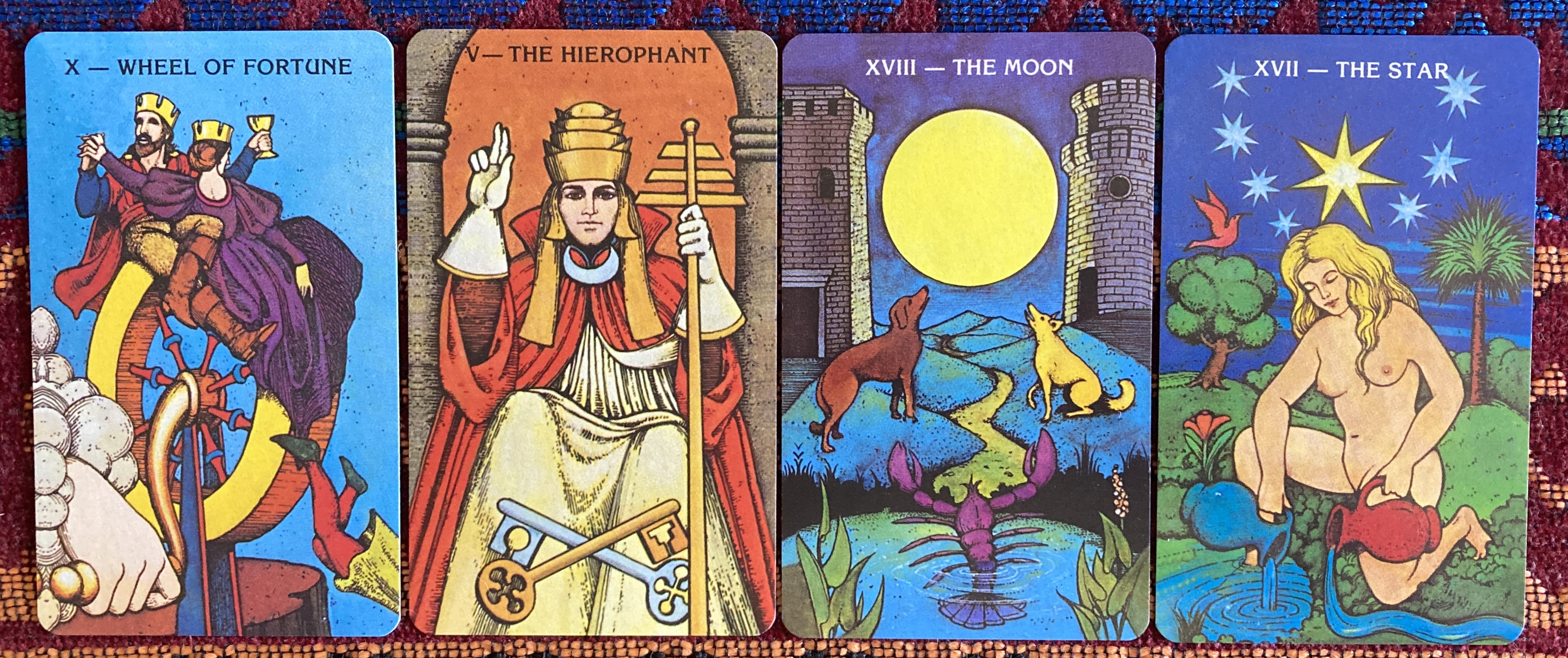
The Morgan-Greer Tarot reimagines this card beautifully. The main figure's human face emerges from the trees in the forest, mirroring the divine hand emerging from the clouds. Three cups stand on the ground, symbolizing the need for physical sustenance, while the fourth cup suggests that physical well-being also requires spiritual nourishment. The Knight of Swords in this deck clearly delivers a crucial message: don't rush! The burning Tower is reflected in the knight's sword, indicating that his hasty actions have led to disaster. Other cards also stand out. The Wheel of Fortune gives a humorous nod to Monty Python's Flying Circus while seriously portraying the downward turns of Fate. The Hierophant, meanwhile, sheds most (but not all) of the negative associations of oppressive power and ideology, offering a more positive representation. The deck’s borderless design enhances its appeal, with the image in the Four of Swords creating its own border. The Morgan-Greer Tarot is a brilliant alternative to the Waite-Smith deck. Its powerful imagery invites your intuition and imagination to roam freely. Every tarot reader seeks "The Deck," and I think I’ve found mine. This deck reinvigorates Pamela Colman Smith's images.
Monday, July 1, 2024
The Hanson-Roberts Tarot is Delightful!
Years ago, I would spend hours browsing through deck images on the tarot site Aeclectic.net, and I often considered purchasing this deck for myself. I've always affectionately called it "the little girl's tarot," but after seeing it in person, I realize it's much more than that.
The cards are semi-matte rather than glossy, which gives them a more artistic and adult feel. The artwork is gorgeous, obviously intended to be a tribute to Pamela Colman Smith’s iconic 1909 deck. The colors are vibrant and add a fresh perspective to the images.
It will be interesting to see how changes in the imagery may affect interpretations of the cards. Will I find that meaning has been lost, or that new meanings have been unveiled? Typically, I study a new deck thoroughly before using it, but with the Hanson-Roberts Tarot, I feel compelled to tuck it away safely so that when read with it, the imagery will still be new, surprising, and enlightening.
After my first thorough shuffle of the deck, three cards were revealed that beautifully encapsulate what I hope is the essence of this deck. The Queen of Wands encourages us to grow spiritually.
The Four of Wands celebrates the fruits of our endeavors.
The Star reveals our consciousness now awakening to new ideas and aspirations.
This deck has already begun to weave its magic! I'm very excited to have it in my collection. Have you had any experiences with the Hanson-Roberts Tarot? I'd love to hear your thoughts about it!
Contemplative Tarot - Seeking Victory
Embrace the body with joy-- it is the source of soul.
Surrender to the unfolding of life, and seek vision in the divine.
The Four of Cups
A man sits against a tree, arms and legs crossed in a closed posture. Three cups rest before him, while a fourth is offered by a hand emerging from a cloud. His eyes are shut; he’s unaware of his surroundings.
This card speaks to introspection and emotional withdrawal. Is the figure lost in apathy—or is he consciously turning inward, like the Buddha under the fig tree? The image invites us to consider whether our stillness stems from resistance or deep reflection.
The Empress
A beautiful woman reclines against cushions, dressed in a flowing gown patterned with pomegranates. She sits in a field of ripening wheat, with a forest and waterfall behind her. A heart-shaped shield marked with Venus rests nearby. A crown of stars and laurel wreath adorn her head, and she holds a scepter topped with a globe. This card represents fertility, abundance, and loving care. The Empress reminds us to nurture what we love, to live in harmony with nature, and to honor the cycles of growth and creation.
The Hanged Man
Suspended upside down from a living tree, the man hangs by one foot, his other leg bent. A halo surrounds his head. His shirt defies gravity, suggesting a choice rather than punishment. The tree is vibrant with green leaves.
This card embodies surrender and new perspectives. The Hanged Man shows us that insight often comes when we let go. In moments of powerlessness, we may gain clarity by accepting what is and viewing life from another angle.
Reflection
Notice where discontent or emotional numbness is blocking your growth. Then gently shift your attention toward what brings you peace, beauty, and gratitude. Care for your mind by seeking inspiration; care for your body by grounding yourself in pleasure and vitality. Life will never be fully in your control, but your perspective is always yours to choose. Begin where you are, and seek the kind of victory that restores your strength and renews your spirit.
Tuesday, June 18, 2024
Casting in The Ballad of Songbirds and Snakes
Despite my initial skepticism, which was based on casting that I saw in the trailers, I wanted to see the movie so I could hear the songs. The songs were indeed great, and to my surprise, I enjoyed the movie. The screenwriter crafted a well-paced adaptation of the novel. However, some casting choices and certain gaps in storytelling may confuse viewers unfamiliar with the source material.
Casting Critiques
The teenage characters were played by older actors. This wasn’t necessary, as there were no sexually explicit scenes to justify such casting.
Lucy Gray Baird: Rachel Zegler's singing is fantastic, but the orphaned entertainer from the poorest district in Panem is not who we see on the screen. Lucy’s vivid clothing and heavy makeup, which should evoke an unsophisticated performer's gaudy flair, are muted in the film. Zegler’s demeanor is too polished, lacking the grit and passion of the young woman in the book.
In the book, we spend most of the Games wondering where Lucy is and what she is doing. Coriolanus can only watch the Games on television; there are few cameras in the arena and fewer microphones. So, like Coriolanus during the Games, we worry about her, and like Coriolanus after the Games, we wonder uncomfortably about the killing she had to do to survive the Games. In the movie, Lucy Gray is uncomplicated: a girl fighting for her life. We don't have doubts or questions about her motivations.
Reaper: The casting of Dimitri Abold was good, but his character received little screen time.
For me, Reaper is the most intriguing and most frustratingly undeveloped character in both the book and the movie. Suzanne Collins leaves us to speculate what inspired his change of strategy in the book. Before the Games, Reaper apologizes to each of the other tributes for having to kill them and, when he first enters the arena, he is still prepared to kill them. However, in the end, he kills no one. Instead he creates a "makeshift morgue" covering the dead tributes' bodies with the flag of Panem. (In the movie, this occurs immediately after the death of the little girl from his district, Dill.)
In the movie, he dies bravely. I didn't mind that he dies much earlier in the movie than in the book, but I wanted some insight into his character. There is no indication of his internal struggle or shift in strategy.
Coral from District 4: Mackenzie Lansing steals Reaper's spotlight by being a believable bully. In the movie, her dying words, "I couldn't have killed them all for nothing," echo Cato's realization in the first Hunger Games movie. (In the book, Coral is literally a backstabber, but her role in the book is much smaller than it is in the movie.)
Dean Casca Highbottom: Peter Dinklage’s portrayal could have been stellar if only he had better direction. The character of Highbottom in the book is beaten down and passive aggressive. He has spent years nursing feelings of resentment and drugging his guilty conscience for the barbaric Games. He resents his own choices in life, blaming Coriolanus's father for them. His venom for Coriolanus is fully revealed only when they are alone together.
Dr. Volumnia Gaul: Viola Davis is stunning as Dr. Gaul! Suzanne Collins never convinced me that Dr. Gaul was a real person, but Viola Davis did. The actress isn't an old, stooped woman as described in the books, but she is a compelling presence. (Her name suggests she’s even more barbaric than others in the Capitol.)
Sejanus Plinth: I liked Josh Rivera, but the actor seemed too old to play a high school student, and the movie script transformed him into a confident and clever adult. In the book, he was an angsty teenager; a kid with a good moral compass, but immature and weak. Since we see him only from Coriolanus's perspective in the book, readers may find Sejanus frustrating, even though we know he is in the right. In the movie, we are free to like him-- which I did. (Suzanne Collins wrote Katniss in the first person; why did she write Coriolanus in the third?)
Tigris Snow: Hunter Schafer is the only actor I wholeheartedly love in the movie. She plays a young woman thrilled with fashion and grateful to her employer, as well as a thoughtful advisor, a protective mother-figure, a compassionate human, and, most beautifully, a woman saddened by shameful things she had to do to survive. In the book, Coryo fails to truly recognize Tigris's worth, even though he relies on her for good advice, guidance, and support. In the movie, we never doubt that she loves her younger cousin. We get to see mature Tigris, loyal, compassionate, and loving. We also have the opportunity to see her recognize Coryo’s dark transformation. (We know that Tigris-- not Tigress-- later emulates cats in her fashion choices, but I wonder why Suzanne Collins named her after a river where an ancient non-Roman civilization developed?)
Gradma'am: Fionnula Flanagan shines as the family's matriarch. In the books, she is deteriorating mentally and physically, but in the movie she clearly portrays the primary (and darkest) influence on Coriolanus’s world view and character.
Lucretius "Lucky" Flickerman: Jason Schwartzman's character highlights that the Games’ are just in their formative stages. The movie character is more competent and professional, but the movie still conveys his shallowness. (What is that pin he's wearing during the Games?)
Hilarius Heavensbee: Florian Burgkart as Hilarius Heavensbee is barely more than an extra. The character in the book is surprisingly forgettable, except for the name he shares with Plutarch Heavensbee who plays such a large role in the rebellion of The Hunger Games trilogy.
Pluribus Bell: Not every character in a book can be included in a movie adaptation, but I wish Pluribus Bell had received a cameo. Pluribus was a bit of light in a dark story. I wondered at his motivation for his support the Snow family. Did he recognize that "Snow lands on top" or was he simply a good guy and a friend of the family? Coriolanus Snow: While no one could emulate Donald Sutherland's smile, Tom Blyth and the director could have at least tried to show the charm that was Coriolanus's original weapon of choice. I don't see a strong physical resemblance between Tom Blyth and Donald Sutherland, who played the older Coriolanus Snow, but his facial features would have been irrelevant if he had convincingly portrayed Coriolanus Snow's character.
Story Telling Critiques
Despite knowing what kind of person Coriolanus eventually becomes, readers of the book find themselves hoping that Coriolanus's good traits will triumph over his bad ones. The movie obscures those bad traits, and viewers who are unfamiliar with the series may be surprised by his actions at the end of the movie. The film also fails portray the two potentially life changing relationships in his story: with Sejanus and with Lucy. I never believed in the romance with Lucy Gray. That love should have been showcased in the movie and been the point at which Coriolanus becomes Snow.
The movie attempts to draw parallels between Coriolanus and Katniss (of the original Hunger Games series) by highlighting their shared experiences of hunger, the struggle to survive, and the loss of parents. Unlike Katniss, he doesn't take care of others, he doesn't recognize what he owes other people, he doesn't have friends, and he doesn't reflect on his motives. Why did the writer and director feel they needed to invent a similarity between Coriolanus and Katniss? (And why, as in a previous movie, did they again present the false narrative that Suzanne Collins implies is disinformation: Dr. Gaul, not the rebels, bombed the arena, just as Alma Coin, not President Snow, arranged the hospital bombing in District 8.)
In the book, Coriolanus Snow's character is already deeply flawed before the events of the story unfold. Raised as an elite Capitol citizen, he has a sense of entitlement and superiority. Despite his family's financial struggles, he strives to maintain an image of power and wealth, driven by a desire for control and dominance.
Coriolanus feels no gratitude and has no sense of indebtedness to those who have helped him, seeing favors and kindness only as opportunities to further his ambitions. He watches and tries to understand other people, but his relationships are calculated, aimed at maintaining his status and securing his future. He lacks both empathy and a moral compass, viewing people as tools to be manipulated. His friendship with Sejanus is deception and his love for Lucy Gray is possessive rather than selfless, showing his inability to form genuine connections.
His indoctrination and inherent ruthlessness, as described in the books, make readers realize that no amount of love or influence could have redeemed him. The film doesn't show those aspects of his character.
In the book, Tigris gives us a hint of his childhood innocence. “I keep wondering how it came to this. That my baby cousin, who wouldn’t hurt a fly, has to fight for his life in the arena... I just hate what they’re doing to you."
Since Coriolanus lacks self awareness, a reader may not recognize that he is a fundamentally bad person until the end of the story when he embraces Dr. Gaul’s mentorship. The movie does not show his deep character flaws, and that may leave viewers still wondering why he turned into a bad person. Before the denouement in the movie, we have no indication of his character until his Anakin Skywalker moment, when he tells Tigris that killing Bobbin, one of the tributes, "felt powerful."
The film progresses faster than the book but fails to fully explain its characters. We don’t see Coriolanus’s complexity and darkness or his disdain for Sejanus. The book has him doing significant things (the handkerchief and the recording) without conscious awareness of what he is doing or why. The book’s insights into his internal struggles are crucial to understanding his transformation into President Snow, which the movie doesn’t adequately convey.
The movie could have created a believable romance with Lucy Gray to suggest that there was hope for him. However, I never believed in their romance ("Make me believe it, Miss Everdeen") and I was completely thrown by Lucy Gray's bizarre lines near the end of the film.
Conclusion
We don't see the complexity or darkness of Coriolanus's character in the movie. In the books, we are aware of Snow's developing awareness that he feels something toward Lucy Gray and we are invested in his finding her after the Games. That romance is important because it might have drawn Coryo away from his destiny of becoming President Snow. The book's insights into Coriolanus's thoughts make us wonder if he can truly love. Unfortunately, neither actor seems to put any effort into portraying a love story.
In both the book and the movie, Lucy Gray remains an enigma.
In the movie, when the two reach the lake, Lucy Gray suggests they keep traveling in the storm, so perhaps she guesses that Billy Taupe's friend hid the guns in the cabin. While Coriolanus moves the floorboards to get fishing rods, Lucy remains planted by the door rather than entering the room to start a fire or sit down. After he finds and shows her the weapon that he had used to kill Mayfair, her words become sinister and threatening– it's startling and bizarre!
In the book, Lucy Gray's and Coriolanus's last scene leaves us with the possibility that what occurred was only in Coriolanus's obsessive mind. (On reflection, we know enough about Lucy Gray to believe that she is savvy and experienced enough to put the pieces together and then run for her life.)
The book and the movie attempt to show us how young Coriolanus became villainous President Snow. The movie does not succeed because it ignores character development. The book has better character development, but was too contrived. Nonetheless, I did enjoy them both.
Sunday, June 9, 2024
Egipcios Kier * 53 Hostility
Stuart Kaplan identifies them as foreign mercenaries who served in the Egyptian world. Whatever their historical identities, the image reminds us that conflict is an unavoidable part of human life. The question is not whether we will face opposition, but how we will meet it.
The symbols surrounding the scene reinforce that theme. Kaplan identifies the arm holding a hook beneath the image as the hieroglyph for strength. The Hebrew letter Mem (מ), often associated with water, quietly suggests that true strength is not always rigid. Like water, it can endure, adapt, and overcome.
Kaplan associates the card with courage, skill, youthful strength, and determination. Nelise Carbonare Vieira links it with the Knight of Swords, whose greatest gift is decisive action in service of an ideal.
That correspondence feels right to me. The Knight of Swords is courageous, but courage without wisdom easily becomes recklessness. Strength is admirable only when guided by purpose.
Every life includes conflict. Sometimes we must defend those we love. Sometimes we must stand against injustice. At other times, the battle is entirely within ourselves, requiring us to confront fear, resentment, or despair.
Hostility reminds us that strength is not measured by our ability to defeat an enemy. It is measured by what we choose to defend.
Friday, June 7, 2024
Egipcios Kier * 60 Evolution
The ritual suggests that every true transition requires finding a new voice.
Stuart Kaplan explains that this ceremony prepared the deceased for the journey into the unknown. The card therefore speaks of change, departure, and transformation. Evolution is not merely becoming different. It is becoming capable of entering a new stage of life.
The surrounding symbols reinforce that idea. Above the scene, the ba, the winged aspect of the soul, rises carrying the tyet, symbol of life and renewal. Below, the reminder that "the body is corruptible" points to a profound truth: while the body changes and perishes, the journey continues.
One detail from Egyptian archaeology has always stayed with me. In at least one burial, a woman's Opening of the Mouth ceremony was never performed, and her name was deliberately misspelled on her coffin. According to Egyptian belief, she would have been unable to speak her true name before the judges of the afterlife. Whether this was an act of malice, political intrigue, or something more mundane, I find it chilling. To erase someone's name is, in a sense, to erase the person.
Nelise Carbonare Vieira associates this card with the traditional Five of Swords, a card that asks whether victory gained at another person's expense is ever truly a victory. Read alongside the archaeological evidence, that correspondence becomes especially poignant. Silencing another person may grant someone power, but it diminishes both the silenced and the one who does the silencing.
Perhaps evolution begins when we reclaim our own voice while refusing to take another's away.
Like the ancient priest, we are called to help one another speak, to be known by our true names, and to enter each new stage of life with honesty and courage.
Wednesday, June 5, 2024
Egipcios Kier * 18 The Moon
The Moon has long been associated with illusion, uncertainty, dreams, and the subconscious. Yet moonlight does something remarkable. It doesn't banish the darkness. It softens it, revealing just enough for us to keep walking.
Like the traditional tarot image, this card shows two canines gazing toward the moon. Here, the wolf becomes the jackal of Anubis, guide of the dead, while the crayfish is replaced by a water scorpion, a creature that lives between water and air. Together they evoke instinct, mystery, and the unseen paths we must sometimes follow.
Unlike many tarot interpretations that emphasize fear and deception, I've come to appreciate the moon differently. Over the years I've noticed how moonlight transforms an ordinary landscape. Harsh edges disappear, familiar places become mysterious, and a quiet path emerges where none seemed visible before.
Perhaps intuition works the same way. It rarely floods us with certainty. Instead, it offers enough light for the next step. We don't need to see the whole journey before we begin walking.
Nelise Carbonare Vieira describes this card as a search for one's true identity, the recovery of forgotten gifts, and a gentler way of expressing ourselves. Her words are compatible with the moon's quiet guidance.
The Moon reminds us that not every path is meant to be walked in daylight. Sometimes wisdom comes softly, inviting us to trust what we can already see rather than fearing what remains hidden.
Sunday, May 26, 2024
Egipcios Kier - Nelise Carbonare Vieira's Interpretations
My Situation: 3 The Empress
Themes: Internal reorganization, expansion of relationships, planning, and strategic creation.
You are currently in a phase of mental and strategic reorganization, using your skills and knowledge to weave new relationships and opportunities. This period is more about planning and reflecting rather than immediate action. You have a strong ability to communicate and express your ideas, which will help you expand your influence in society. Your creativity is high, and it’s important to balance this with rationality and diplomacy.
Influencing My Situation: 72 Purification (Four of Pentacles)
Themes: Enlightenment, clarity, and security through understanding.
This is a time of personal clarity and revelation. Your ideals are becoming clear, and you feel in tune with the universe, which helps you understand others better. This clarity allows you to focus your energy on the right paths and make decisions that align with your goals. You'll experience a sense of security as you eliminate doubts and confirm your direction.
Basis or Cause of My Situation: 61 Solitude (Seven of Swords)
Themes: Reflection, introspection, and deep awareness.
You've been isolating yourself from external interference to better understand your values and goals. This is a period of deep introspection, during which you can discern your own challenges separate from others'. It's a time to focus on your own issues and strengths, away from the expectations of others.
A Potential Situation, If I Work Toward It: 37 Art and Science (King of Cups)
Themes: New ways of being, social renewal, and incorporation of gifts.
You are defining a new way of being and opening paths to play new roles in society. This transition phase involves reassessing and expanding your relationships and social environment. It's a time to focus on activities and relationships that truly involve you, allowing you to explore your potential fully.
My Recent Past: 1 The Magician
Themes: New beginnings, structure, creation, and self-expression.
You have recently entered a cycle in which you are defining the foundations for your development. This period involves a lot of self-discovery and reorganization, using your inherent gifts and knowledge to pursue your goals. You are poised to take action, equipped with the necessary tools to create a solid foundation for your future.
My Near Future: 52 Premeditation (Queen of Swords)
Themes: Strategic planning and self-awareness.
You are becoming aware of your capabilities and limits. You are strategically planning the best ways to use your knowledge and resources to achieve your goals. This card emphasizes the importance of thoughtful action and clear planning, ensuring you are prepared for success.
Myself: 8 Justice
Themes: Reevaluation and redirection, rescue of ideals and abilities, resumption of self-love.
You are focusing on discovering and using your gifts to fulfill your mission. You are taking stock and engaging in self-reflection. It's time to recognize your right to pursue your own will and prioritize your personal goals. You have spent considerable effort on others' problems and achievements, but now it's essential to focus on yourself. Acknowledge your capabilities and use them to promote your own ideals.
My Environment: 70 Cooperation (Two of Pentacles)
Themes: Full harmony with environment and in tune with one's being.
This card signifies a period of perfect alignment with your core, allowing external connections to flow seamlessly and support your goals. This time is marked by mutual cooperation and a heightened sense of responsibility towards community action. You are encountering people and situations that align with your goals, offering support, opportunities, and harmonious relationships.
My Hopes or Fears 51 Advice (King of Swords)
Themes: Defining a new role and establishing guidelines to promote greater personal fulfillment.
Defining new objectives and directions and focusing on using your skills to achieve fulfillment. A period of integration and satisfaction through the use of your abilities. The beginning of a significant new phase.
The Outcome: 23 The Laborer (King of Wands)
Themes: Construction, birth, creation, work, sowing, redefining daily life.
Summary: This is a period of establishing new foundations and structures. You will be organizing and setting concrete objectives for long-term stability. Opportunities will emerge to lay down roots and build a stable foundation. This card often indicates significant life changes that bring material or emotional stability.
Friday, May 24, 2024
Index of Egipcios Kier posts
I have been analyzing cards from the Egipcios Kier Tarot Deck, relying on the imagery of the cards, Stuart Kaplan's LWB, traditional tarot meanings, and Nelise Carbonare Vieira's website, Tarot Door. So far, I have reviewed less than a quarter of the deck, but here is an index of all the cards; it contains links to posts I've completed.
1 The Magician
2 The Priestess
3 The Empress
4 The Emperor
5 The High Priest
6 The Lovers
7 The Chariot
8 Justice
9 The Hermit
10 Wheel of Fortune
11 Strength
12 Hanged Man
13 Immortality (Death)
14 Temperance
15 Passion (Devil)
16 Obelisk (The Tower)
17 The Star
18 The Moon
19 The Sun
20 Resurrection (Judgment)
21 Transformation (The World)
22 The Fool
23 The Laborer (King of Wands)
24 The Weaver (Queen of Wands)
25 The Navigator (Knight of Wands)
26 The Prodigy (Page of Wands)
27 The Unexpected (Ten of Wands)
28 Uncertainty (Nine of Wands)
29 Domesticity (Eight of Wands)
30 Exchange (Seven of Wands)
31 Impediment (Six of Wands)
32 Magnificence (Five of Wands)
33 Alliance (Four of Wands)
34 Innovation (Three of Wands)
35 Desolation (Two of Wands)
36 Initiation (Ace of Wands)
37 Art and Science (King of Cups)
38 Duplicity (Queen of Cups)
39 Testimony (Knight of Cups)
40 Premonition (Page of Cups)
41 Dissension (Ten of Cups)
42 Preeminence (Nine of Cups)
43 Delusion (Eight of Cups)
44 Expressiveness (Seven of Cups)
45 Regeneration (Six of Cups)
46 Patrimony (Five of Cups)
47 Conjecture (Four of Cups)
48 Consummation (Three of Cups)
49 Versatility (Two of Cups)
50 Attraction (Ace of Cups)
51 Advice (King of Swords)
52 Premeditation (Queen of Swords)
53 Hostility (Knight of Swords)
54 Examination (Page of Swords)
55 Contrition (Ten of Swords)
56 Pilgrimage (Nine of Swords)
57 Rivalry (Eight of Swords)
58 Meditation (Seven of Swords)
59 Revolution (Six of Swords)
60 Evolution (Five of Swords)
61 Solitude (Four of Swords)
62 Proscription (Three of Swords)
63 Communion (Two of Swords)
64 Vehemence (Ace of Swords)
65 Apprenticeship (King of Pentacles)
66 Perplexity (Queen of Pentacles)
67 Veneration (Knight of Pentacles)
68 Speculation (Page of Pentacles)
69 The Unforseen (Ten of Pentacles)
70 Cooperation (Nine of Pentacles)
71 Avarice (Eight of Pentacles)
72 Purification (Seven of Pentacles)
73 Love and Desire (Six of Pentacles)
74 Offering (Five of Pentacles)
75 Generosity (Four of Pentacles)
76 The Provider (Three of Pentacles)
77 Confusion (Two of Pentacles)
78 Rebirth (Ace of Pentacles)
Friday, May 17, 2024
Egipcios Kier Tarot * 29 Domesticity
The surrounding symbols reinforce that idea. Kaplan notes that the scarab represents renewal, while the vessel below symbolizes the heart, the place where our inner life is held. Together they suggest that a true home is not merely a place, but a way of living in harmony with the world around us.
One detail especially caught my attention. A hieroglyph resembling a knife appears above the scene. At first it seems to threaten the card's peaceful mood. Yet Kaplan explains that gazelles were sacred animals whose movements signaled the coming of the Nile flood, the event upon which Egypt's survival depended. Perhaps the knife is not a threat to the gazelle at all. Instead, it reminds us that human beings flourish not by conquering nature, but by learning its rhythms and working within them.
Nelise Carbonare Vieira associates this card with the traditional Eight of Wands, a card of movement and opportunity. The connection surprised me at first, but I find it persuasive. The boy has already reached out and taken hold of the opportunity before him. He does not force it; he responds to it.
Domesticity, then, is more than hearth and home. It is learning to live in right relationship with nature, with community, and with the rhythms that sustain life.
Friday, May 3, 2024
Art Opening - The Magick of Kesam Katz
ART OPENING
The Magic of Kesam Katz!
Born in 1943 in Bonne Terre, Missouri, USA, Kesam embarked on a lifelong artistic journey, eventually making aliyah in 1996 and settling in Eilat, where she has immersed herself in the inspiring natural beauty of the landscape for the last twenty years.
Transitioning from her acclaimed work as a fiber artist, Kesam now channels her creativity through the delicate mediums of pencil and watercolors.
Join us for the unveiling of Kesam Katz's latest collection at her exclusive exhibit opening.
Date: Tuesday 7 May 2024
Time: 11 a.m. to 1 p.m.
Location: Bayit BaLev, First Floor Lobby, Hatmarim 39, Eilat (Behind Macabi)
Experience the allure of Kesam's evocative artworks, where each stroke tells a story and every shade ignites the imagination. Don't miss this opportunity to immerse yourself in the enchanting world of Kesam Katz.
Sunday, April 21, 2024
The Flowering of an Indigenous Culture
Once upon a time—before 1967—Arabs in Israel, Judah, Samaria, and Gaza did not call themselves Palestinians; they were Arabs. Back then, if you said "Palestinian," everyone assumed you meant a Jew. For example, The Palestinian Post, founded in 1932, was a Jewish paper. (The local Arab paper was called Al-Jami'a Al-'Arabiya.)
Then, in 1959, came Yasser Arafat, an Egyptian born in 1929, who-- with a little help from the Soviet Union-- rebranded the Muslim Arabs of the region. Suddenly, they were "Palestinians" and claimed a deep, ancient connection to the Land. Along the way, they also borrowed the keffiyeh from Iraqi Arabs, because nothing says "indigenous" like a headscarf from another country.
To this day, Palestinian identity remains a patchwork. Culturally, they are not a single people. Palestinian Muslim women don’t even share a common style of modest dress—some are covered head-to-toe in black, others wear tight jeans and revealing tops but cover their hair, while some opt for long raincoats year-round. The only common thread in Palestinian dress? That borrowed keffiyeh.
Their actual roots? A mix of 19th and 20th-century immigrants from Egypt, Syria, and Lebanon. A few were in the land before the 19th century and some of those families may have been Jewish before the Muslim conquest of the Land in the 7th century.
Meanwhile, according to the UN’s own definition of indigeneity—having historical continuity with pre-invasion societies and maintaining a distinct culture—Jews are, without question, the indigenous people of Israel. Our culture was born here, shaped here, and we maintained a presence here through multiple colonial empires: Assyrian, Babylonian, Greek, Roman, Arab Muslim, Ottoman Muslim, and British, to name a few. Coins minted by many of these empires acknowledged the Jewish connection to the Land by featuring Jewish symbols, such as a menorah or the Hebrew words ארץ ישראל (Land of Israel).
Palestinian culture also meets one requirement for indigeneity: its current culture developed in this Land-- within the last 70 years). However, this culture does not spring from a connection to the Land or a people, but from a single, unifying obsession: hating and killing Jews.
The flowering of this culture occurred on October 7, 2023, which tells you everything you need to know.
Sunday, April 14, 2024
The Magic in Our Tradition
How can we recall four-thousand-year-old miracle stories now? While 134 of us are held in brutal captivity! While nine young women, if they are still alive, may be almost seven months pregnant from rape! While war is knocking on our door daily! While the world world seems to be howling its hatred of us!
How can we transition from our current reality to our traditional celebration? Where can we find words to plead for our deliverance?
Instead of words, we could turn our focus to the fifteen silent ritual actions performed during the seder meal, hoping that these rituals will move G-d to protect and preserve us.
- What will it signify when we lift our glasses of wine but refrain from drinking?
- This year, what will it mean to dip the green vegetable in salt water?
- As our leader breaks the middle matza, what else will we hope or fear may be broken?
- Why will we cover the matza whenever we lift our cups of wine?
- As we diminish our joy by removing drops of wine from our full glasses, what losses will we mourn?
- What will we understand when the leader lifts the full round seder plate and the matzot?
- Will our search for the Afikomen be a prayer for the redemption of our hostages still captive in Gaza?
- And what will we see when open the door for Elijah the Prophet?
May the mute gestures of this seder stir our hearts and reach the heavens, so that G-d will again protect and preserve all of us.
And as for words... that one passage we always skip? This year I will shout it out with tears in my eyes.
My thanks to Bob Silber, a fellow English speaker in Eilat, whose profound insights into this year's seder, inspired my reflections.
| "The Mute Book," a chapter from Ira Steingroot's book, Keeping Passover |
Saturday, March 9, 2024
Egipcios Kier - 71 Avarice
The lower portion of the cartouche contains a large jar adorned with uraeus serpents. It resembles the canopic jars used to preserve the organs of the dead. Whether or not that association was intended, the image quietly reminds us that wealth cannot outlast mortality. Eventually every account is closed.
Above the scene appear the Hebrew letter Tet (ט), several magical symbols, and what Kaplan interprets as either a waning moon or the wounded Eye of Horus. Even abundance is subject to loss.
Kaplan associates the card with greed, possessiveness, and the inability to share. Reversed, he suggests obstacles, setbacks, and frustrated ambition.
Nelise Carbonare Vieira pairs Avarice with the traditional Eight of Pentacles, a correspondence that initially surprised me. The Eight of Pentacles honors patient craftsmanship and the satisfaction of honest work. Avarice asks a different question: What is all that work for?
Labor can become an act of service, creativity, and provision for those we love. But it can also become an endless pursuit of more. The difference lies not in the work itself, but in the heart of the worker.
The man on this card may simply be taking inventory. Or he may already have more than enough and be unable to recognize it. Avarice reminds us that contentment is not measured by what we possess, but by knowing when enough is enough.
Tuesday, February 27, 2024
Egipcios Kier * 36 Initiation
Card 36 is watched over by Taweret, the Egyptian goddess of childbirth and protection. Although she combines the forms of a hippopotamus, lion, and crocodile, ancient Egyptians especially admired the fierce devotion of the female hippopotamus in defending her young. Taweret's strength is expressed not through conquest, but through care.
She walks beside a small human figure, probably a woman approaching childbirth for the first time. The initiate carries the ankh, symbol of life, while Taweret holds the tayet, the girdle of Isis, another emblem of protection and renewal. Together they suggest that initiation is not simply acquiring knowledge. It is accepting the responsibilities that accompany new life.
The symbols surrounding the scene reinforce this theme. The Hebrew letter Tzadi, the serpent associated with birth, and the seated teacher all point toward preparation, guidance, and transformation. We rarely enter a new stage of life entirely alone.
Stuart Kaplan associates this card with childbirth, feminine power, progress, and artistic inspiration. Nelise Carbonare Vieira pairs it with the Ace of Wands, the spark of new beginnings and creative potential. The connection feels natural. Every true beginning asks us to become someone we have not yet been.
Whether we are welcoming a child, beginning a vocation, creating something beautiful, or simply growing into a wiser version of ourselves, initiation is both gift and responsibility.
Like the small figure in this card, we do not take those first steps alone. Wisdom walks beside us.
Saturday, February 24, 2024
An Inquiry with the Oneness Tarot
So my friend, Yael, suggested that I engage the deck in dialogue through a series of questions. In this post, I consider the insights that emerged from this unusual interaction.
Who are you?
I am the Queen of Cups gazing into the cup of vision, the primordial sea, our collective soul. Beyond my compassion and understanding, I am also a source of creative solutions.
What kind of questions do you most like to consider?
As the Page of Wands, I am filled with wonder and excitement, preferring questions that are grounded in reality, but that also seek the spark of the divine in this world.
What are your strengths?
As the Nine of Pentacles, I offer a time of serene contemplation and wholeness. I can lift you beyond current limitations, nurture gratitude, and foster a sense of self worth.
What are your weaknesses?
With the Three of Wands, I acknowledge my limitations in the realm of action and implementation of plans. Although I can share my foresight and guidance, I cannot travel the path with you. You must be your own agent of change.
How do you see me?
I see you as the Ace of Pentacles, a seed bursting with potential, brimming with the creative energy and the capacity to nurture growth and abundance—but only if you seize this time!
What can I do to create a strong connection between us?
Make offerings of fresh water to me as Temperance. Recognize me as a bridge between earthly and celestial realms. Cultivate patience, balance, and reverence when interacting with me to create a harmonious bond between us.
What mindset should I take upon myself when I reach out to you so I understand your answers better?
Embody the symbolism of the Ace of Swords by approaching me with clarity of intention and mental focus. Let my insights resonate deeply within you.
These insights from the Tarot of Oneness offer me a path to self discovery and self improvement. As I continue to work with this magical deck, I will embrace not just its answers, but the transformative power of inquiry itself.
Saturday, February 10, 2024
Tarot of Oneness by Robyn Voisey
The Tarot of Oneness by Robyn Voisey is a captivating reinterpretation of the Pamela Colman Smith deck, offering the opportunity to immerse yourself in each card's imagery. In this deck, we are invited to be the figure portrayed in the traditional deck. Upon my initial flip-through, the deck's vibrant energy captivated me, with only a handful of cards obviously requiring that I spend more time in them.
QUEEN OF PENTACLES
The Queens—renamed Spirit in this deck—are particularly alluring. Robyn Voisey’s Spirit of Pentacles is wearing the same green dress as Robin Wood’s Queen of Pentacles. Since you are the figure in the card, you can gaze down at the pentacle in your lap and also see an adorable bunny at your feet. The usual interpretation is that the Queen of Pentacles is aware of her life’s limitations, but is grateful for what she does have. In a negative light, she may be overly concerned with money or unable to find satisfaction in her work. When I enter Voisey’s card however, I feel wealthy and lucky. My bare feet soak up the healing energy of the earth, my gown feels rich against my skin, and I feast my eyes on the colors and sights around me.
FOUR OF WANDS
The style of one card diverges from the rest of the deck, but it is a real place. The trippy portrayal of the Four of Wands can be nowhere other than the Nova Music Festival near Re’im. The card’s number, Four, associated with boundaries and borders, underscores the need to ensure one’s safety before celebrating life. The traditional imagery includes a couple near or under a chuppah at a harvest festival, suggesting that their goals are nearly achieved; often the wall of a fortified city is visible in traditional imagery. When we enter Robin Voisey’s card, we are in invited into an altered state, dancing to uplifing music, lovingly reaching out to others, and feeling at one with the universe. However, the association with the Nova Festival adds an underlying sense of vulnerability and anxiety.
TEN OF SWORDS
Many of the cards convey their traditional meaning even more effectively than their traditional counterparts. A particularly stunning example is the Ten of Swords. The traditional Pamela Colman Smith portrayal features a man face down on the ground with ten swords in his back; incongruently, the traditional interpretation focuses on the end of problems and the imminent sunrise. Robyn Voisey’s more nuanced rendition plunges us into icy waters amidst the wreckage of a ship. A life preserver and other objects nearby offer temporary assistance from drowning, but not from freezing. The rising sun reveals a military ship on the horizon, portending either salvation or destruction. In this card, I feel cold and afraid, but also hopeful and determined to do what I can to help myself.
FOUR OF CUPS
Robyn Voisey’s description of the Four of Cups adheres to traditional meanings, yet her imagery takes us far from that meaning. Instead of the pouting man under a tree, ignoring the three real cups on the ground before him as well as the cup offered by a divine hand, you are shielding your eyes from the blinding sun so you can focus on a small deer in the distance. Because your hand is blocking the light, little color is visible, but at any time you can lower your hand to observe what the sun can reveal. Traditional meanings are lack of passion, resisting change, being self absorbed, failing to see a new opportunity, and the need to honestly evaluate yourself or your situation. The Tarot of Oneness guidebook lists similar meanings: apathy, dissatisfaction, and withdrawal. Robyn Voisey suggests that you need to change your focus and let down your guard but I can’t help seeing the positive in this card. In her image, we are more active than the person in Pamela Colman Smith's image; we’ve made a choice to focus on something that the bright sun obscures.
THE SUN
One card that deeply resonates with me is The Sun card! Its traditional imagery often feels disconnected from its meanings of safety and freedom, childlike joy, growth, and honesty. Typically, we see a baby precariously perched on a horse, a scenario more perilous than reassuring; the wall in the background seems more like Plato’s cave than protection and no infant could hold the enormous red banner. At least Robin Wood made the child’s mount a small pony. However, in Robyn Voisey’s Tarot of Oneness, we find ourselves on the back of a white horse that is cantering along a beach, with susurrating waves on one side and a child’s sandcastle on the other—a scene radiating joy, freedom, and (for the moment) security. In this card, we feel able to embrace life's boundless possibilities with exuberance, confidence, and clear vision.
EXTRA CARDS
Voisey's inclusion of five additional cards will hopefully enrich the deck and add valuable insights into various aspects of life. The Higher Self card, in which you are climbing a heavenly stairway, symbolizes intuitive guidance and self-awareness, facilitating a deeper connection with one's inner wisdom and fostering personal growth.
CONCLUSION
The Tarot of Oneness by Robyn Voisey is a profound tool for diving into the essence of each card, fostering a deeper understanding of its imagery. With its immersive imagery and thoughtful reinterpretations, this deck promises to be my cherished deck for exploration and introspection.
Monday, January 8, 2024
Egipcios Kier - 74 Offering
Above the scene appear a magical letter, a lion, and the Hebrew letter Lamed (ל), whose ancient form resembles a shepherd's staff. Together they suggest courage, guidance, and the willingness to seek wisdom.
Below rests a seated mummy with its bearded head turned backward. Kaplan identifies it simply as a mummy, but the backward-looking head reminds me of an owl, turning to see what lies behind. Mummification sought to preserve the person for the eternal journey. Perhaps this image suggests that enduring hardship and reflecting on the past are themselves part of preparing the soul for what lies ahead.
Nelise Carbonare Vieira associates this card with the traditional Five of Pentacles, a card of hardship, exclusion, and vulnerability. Through that lens, the kneeling figure no longer appears merely devout. She may be seeking help during a difficult season of life.
Kaplan interprets the card as dedication, devotion, and seeking assistance from those in positions of influence. Sometimes faith begins not in certainty, but in need. When our own resources fail, we discover whether we are willing to ask for help.
Reversed, the Five of Pentacles points toward recovery, renewed hope, and the rediscovery of belonging. The temple then becomes more than a place where offerings are given. It becomes a place where weary people are received.
The lion reminds us that courage is often quiet. Sometimes courage means simply walking through the temple doors.
Offering asks a gentle question: What do we bring before the sacred?
Sometimes our gratitude. Sometimes our sorrow. Sometimes nothing more than our need.
Monday, January 1, 2024
Egipcios Kier - 51 Advice
Card 51 shows a man kneeling before a teacher, listening with humility. Stuart Kaplan identifies the standing figure as Imhotep, the legendary architect, healer, and advisor to Pharaoh Zoser. Whether priest, scholar, or physician, he represents knowledge placed in the service of others.
The surrounding symbols reinforce that theme. The Hebrew letter Kaf (כ), meaning "hand," reminds us that wisdom ultimately finds expression in action. The feather of Ma'at evokes truth and justice, while the jackal of Anubis quietly recalls that our time is limited. We seek wisdom not simply to know more, but to live more faithfully.
Kaplan associates this card with practical wisdom, healing, recovery, and the ability to transform ideas into meaningful action. I find that emphasis refreshing. Advice is valuable only when it helps us move from understanding to living.
Nelise Carbonare Vieira associates this card with the King of Swords, a figure of clarity, discernment, and integrity. Like the King, Imhotep embodies the union of knowledge and good judgment. True authority is not loud or domineering. It is earned through wisdom, experience, and a commitment to truth.
Good advice, however, does not ask us to surrender our own judgment. The best teachers help us think more clearly rather than think for us.
Looking back, I realize how much my own life has been shaped by teachers. Some offered answers. Others offered better questions. The ones I remember most did not tell me who to become. They helped me discover it for myself.