Showing posts with label Major: Death. Show all posts

Friday, January 2, 2015

The Fours


The fours of the minor arcana are some of my favorite cards in Joanna Powell Colbert’s Gaian Tarot. They feel like home, in the best sense of the word. Each of these cards shows a container, a safe, nourishing place in which you can grow and express yourself. The fours are earthy cards.

The Four of Air shows a robin’s nest holding four, blue eggs. The nest is a work of art, but it is also hidden. The eggs are safe from predators and the baby birds will be safe until they are strong enough to fly.

In the Four of Fire, four pillar candles and twelve smaller candles delineate a sacred space. Inside the circle, a woman performs a ritual. Abundance flows from the silvery sphere of the moon behind her shoulder—her circle cannot contain it all. She represents our desire to experience more, our desire to make our lives purposeful and meaningful. Can her sacred space become a doorway?

The Four of Water depicts the well at Glastonbury. A woman gazes into it, surrounded by a short, circular wall. This card is mysterious. What does the well contain?

The Four of Earth is a cornucopia. From the opening in a tree trunk, where a squirrel has stored acorns, the seeds of new life pour out extravagantly. In the foreground of the image, there is a blessing cairn, holding and expressing gratitude.

These cards also represent a pause in which we can experience the Force and Source of Life that is behind all that we know, a moment to feel the abundance available to us. Two colors predominate, one cool and one warm, representing the relationship between contemplation and action.

Related to the fours of the minor arcana is the fourth card of the major arcana, The Builder. He creates structures in which to live, places from which we can interact with the world. He represents responsibility and empowerment. What have you created with your life?

Another major arcana card is related to the fours; it is Death. We can embrace our fears and fly across the sparkling water or we can rot here with our decaying boat.

While we remain in our “containers,” we are constricted. A tree can only grow so large in a ten gallon, terra cotta pot. Sometimes, we need to step outside the boundaries we have crafted.

Is it time to build, to be nourished, or to fly? What is the state of the container that you’ve placed your life in?

The card I pulled to answer these questions for myself was the Ten of Fire. It is time to burn this container to the ground, let the smoke clear, and see what’s is out there.


Once you have built something—something that takes all your passion and will—it becomes more precious to you than your own happiness. You don’t realize that, while you are building it. That you are creating a martyrdom—something which, later, will make you suffer. (A Stranger in Olondria by Sofia Samatar)


Friday, November 28, 2014

Storytelling

"Stories are compasses and architecture; we navigate by them, we build our sanctuaries and our prisons out of them, and [not knowing your] story is to be lost in the vastness of a world that spreads in all directions like arctic tundra or sea ice." - cited by Marie Gauthier

Voyager Tarot 
Should you tell your story? XIII Death. It is liberating to discover the lessons your story holds about yourself and the mystery of life. Let your old worldview pass on so that you can embrace your life in a new way.

How? Five of Wands: Oppression. Look at things in a different light. Feed the energy in your body so that you can move forward bravely. Find a structure or a purpose that will keep you focused so that you finish your task.

Why? Two of Crystals: Equanimity. To gain self-awareness and to find a map for the future. To hear the voice of guidance that may begin to speak as the pattern of your story unfolds before you. To see from above the jumble of confusions of your life and thoughts.

When? Eight of Worlds: Change. As you are changing. In other words: Now! But make sure you are being held. Find someone who is generously willing to witness the discovery of your life lessons.

What do you need to know? Five of Worlds: Setback. Defeat and difficulty are regenerative. If things you depended on dried up, then you must reflect before forward movement is possible. Make sure your story tells of your successes and your skills so that you will remember to rely on them. And always care for your body.


Saturday, November 8, 2014

Contemplative Tarot - Carolyn's Question

On her blog, Art of Change, Carolyn Cushing recently offered this question for contemplation: What is the dark offering me in this season of long nights?


…an opportunity to learn from the holidays...


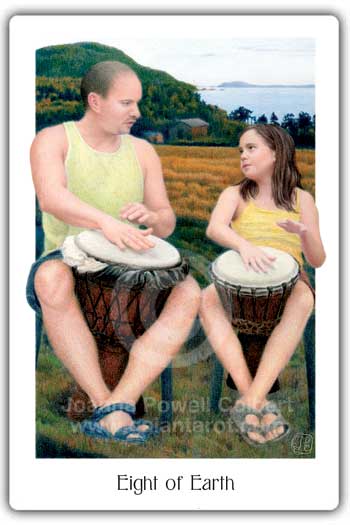
8 of Earth – celebrating outdoors before newly harvested fields. Celebrate as winter approaches, accepting every season as a gift.

After the High Holy Days, came Sukkot, Shemini Atzeret, and Simchat Torah, nine days of celebration and tradition.

During Sukkot, one of the three pilgrimage festivals, many Jews celebrate outdoors, living in temporary shelters representing the structures that the Israelites made during the harvest moon so they could remain near the fields at night; these sukkahs also represent the temporary shelters in which they lived during forty years of wandering in the wilderness. 

Shemini Atzeret is an extra day of festival and seems to have neither agricultural nor historical significance. When describing this holiday, some say that god is like a host asks his guests to… (what's that melody?) stay… just a little bit longer. It is an extra day of togetherness.

Simchat Torah "rejoicing in the Torah." We finish reading D’varim (“These are the words” or Deuteronomy) and begin again at B’reishit (“In the beginning” or Genesis) and begin again. Jill Hammer calls Simchat Torah the Solstice of the Torah because the cycle of readings continues.

These holidays represent celebration of the season's harvest, the passing down of tradition, and a pause to reflect between summer and winter.

Death – the sparkling light on the water draws our attention from the decaying boat to a place of new hope. Be eager to change. 

Shortly after Simchat Torah, we observe the yahrtzeit of Rachel, the anniversary of her death. Later, near the winter solstice, we observe Chanukah.

The Matriarch, Rachel, died giving birth to her second child whom she named Ben Oni, “son of my sorrow.” Her husband, Jacob, sadly buried her by the side of the road. The image of Rachel, crying for her lost children is powerful. Her tears moved god to bring us home.

The Festival of Lights remember the re-dedication of the Temple and encourages us to rededicate ourselves. The Temple was captured and desecrated, but then regained and renewed. Perhaps the seven-branch menorah becomes a nine-branch chanukiah during this holiday because light may sometimes grow brighter after destruction.

These holidays teach us to hold on to hope. Rabbi Alan Berg, currently of Beit Chaverim in Oregon, spoke of breaking a glass at Jewish weddings, "If in the moment of your greatest joy, you can remember your greatest sorrow, then in times of sorrow, you will remember joy."

10 of Fire – combines the imagery of life and destruction. You never know what is next.

Everyone knows there’s spring after winter and light after darkness, but we should not to be blind to the destructive forces that come again and again. The fire represents the Tenth of Tevet, destruction. The trees represent Tu B’Shevat, renewal in spring. The smoke represents Purim.

Purim, observed very near the beginning of spring, is a dark, dark holiday on which god is hidden from us and only chance preserves us. The cycle of the year is not simple or clear. Destruction can come at any time and it may only be chance that averts it.

And yet... it will still be springtime.


Be sure to see Carolyn's blog, here.