Last night, I dreamed I was standing in a threshold—stuck there. My feet wouldn’t move and I was unable to step forward. When I woke up, the feeling lingered.
I’ve thought about leaving Israel countless times, even come close, yet here I am still here. Still hovering in that in-between space. The dream felt like a message, but I needed more clarity. So I turned to my tarot deck.
I drew the Five of Cups reversed, Eight of Pentacles reversed, and the Tower reversed.
Even before analyzing the cards, I could see how they mirrored my situation. Dreaming of being stuck in a doorway captures everything: neither fully in nor out, caught in the space between staying and leaving.
The Cards:
Five of Cups Reversed – This card is about moving past grief, regret, or disappointment. Maybe I am letting go of something... past hopes, past pain, past beliefs about what living here was supposed to be? But if I’ve begun to let go, why am I not moving forward?
Eight of Pentacles Reversed – Stagnation. Lack of progress. Fear. I recognize that I haven't and may never integrate into Israeli life, and yet I can't commit to giving up either. Am I holding myself back because I doubt my ability to start over somewhere new?
The Tower Reversed – Resistance to change. Trying to avoid upheaval. The Tower reversed doesn’t bring sudden devastation but rather a slow, creeping realization that a change must happen. I’ve known for a long time that my values and preferences don’t fully align with Israeli society, and it has become clear that my current life here isn’t sustainable. But knowing isn’t the same as acting. And acting means accepting that there’s no going back. Oy va voy!
The Message
I’m ready to move on, but fear is causing me to hesitate. Fear of upheaval. Fear of failure. Fear of letting go of the place that has shaped me.
But the dream and the reading both make something clear: I am still standing in the doorwayand if I don’t step forward, I will remain stuck between two worlds, belonging to neither. It’s time to decide.
Showing posts with label Minor: 8 Earth. Show all posts
Saturday, February 1, 2025
Saturday, November 8, 2014
Contemplative Tarot - Carolyn's Question
On her blog, Art of Change, Carolyn Cushing recently offered this question for contemplation: What is the dark offering me in this season of long nights?
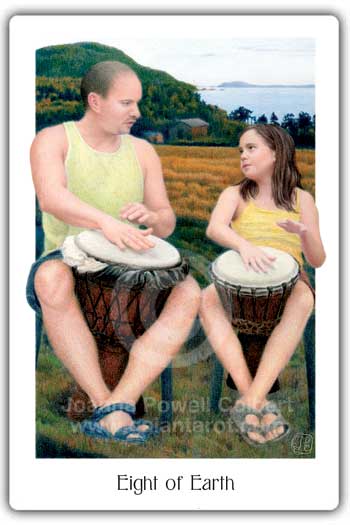
8 of Earth – celebrating outdoors before newly harvested fields. Celebrate as winter approaches, accepting every season as a gift.
After the High Holy Days, came Sukkot, Shemini Atzeret, and Simchat Torah, nine days of celebration and tradition.
During Sukkot, one of the three pilgrimage festivals, many Jews celebrate outdoors, living in temporary shelters representing the structures that the Israelites made during the harvest moon so they could remain near the fields at night; these sukkahs also represent the temporary shelters in which they lived during forty years of wandering in the wilderness.
Shemini Atzeret is an extra day of festival and seems to have neither agricultural nor historical significance. When describing this holiday, some say that god is like a host asks his guests to… (what's that melody?) stay… just a little bit longer. It is an extra day of togetherness.
Simchat Torah "rejoicing in the Torah." We finish reading D’varim (“These are the words” or Deuteronomy) and begin again at B’reishit (“In the beginning” or Genesis) and begin again. Jill Hammer calls Simchat Torah the Solstice of the Torah because the cycle of readings continues.
These holidays represent celebration of the season's harvest, the passing down of tradition, and a pause to reflect between summer and winter.
Death – the sparkling light on the water draws our attention from the decaying boat to a place of new hope. Be eager to change.
Shortly after Simchat Torah, we observe the yahrtzeit of Rachel, the anniversary of her death. Later, near the winter solstice, we observe Chanukah.
The Matriarch, Rachel, died giving birth to her second child whom she named Ben Oni, “son of my sorrow.” Her husband, Jacob, sadly buried her by the side of the road. The image of Rachel, crying for her lost children is powerful. Her tears moved god to bring us home.
The Festival of Lights remember the re-dedication of the Temple and encourages us to rededicate ourselves. The Temple was captured and desecrated, but then regained and renewed. Perhaps the seven-branch menorah becomes a nine-branch chanukiah during this holiday because light may sometimes grow brighter after destruction.
These holidays teach us to hold on to hope. Rabbi Alan Berg, currently of Beit Chaverim in Oregon, spoke of breaking a glass at Jewish weddings, "If in the moment of your greatest joy, you can remember your greatest sorrow, then in times of sorrow, you will remember joy."
10 of Fire – combines the imagery of life and destruction. You never know what is next.
Everyone knows there’s spring after winter and light after darkness, but we should not to be blind to the destructive forces that come again and again. The fire represents the Tenth of Tevet, destruction. The trees represent Tu B’Shevat, renewal in spring. The smoke represents Purim.
Purim, observed very near the beginning of spring, is a dark, dark holiday on which god is hidden from us and only chance preserves us. The cycle of the year is not simple or clear. Destruction can come at any time and it may only be chance that averts it.
And yet... it will still be springtime.
…an opportunity to learn from the holidays...
8 of Earth – celebrating outdoors before newly harvested fields. Celebrate as winter approaches, accepting every season as a gift.
After the High Holy Days, came Sukkot, Shemini Atzeret, and Simchat Torah, nine days of celebration and tradition.
During Sukkot, one of the three pilgrimage festivals, many Jews celebrate outdoors, living in temporary shelters representing the structures that the Israelites made during the harvest moon so they could remain near the fields at night; these sukkahs also represent the temporary shelters in which they lived during forty years of wandering in the wilderness.
Shemini Atzeret is an extra day of festival and seems to have neither agricultural nor historical significance. When describing this holiday, some say that god is like a host asks his guests to… (what's that melody?) stay… just a little bit longer. It is an extra day of togetherness.
Simchat Torah "rejoicing in the Torah." We finish reading D’varim (“These are the words” or Deuteronomy) and begin again at B’reishit (“In the beginning” or Genesis) and begin again. Jill Hammer calls Simchat Torah the Solstice of the Torah because the cycle of readings continues.
These holidays represent celebration of the season's harvest, the passing down of tradition, and a pause to reflect between summer and winter.
Death – the sparkling light on the water draws our attention from the decaying boat to a place of new hope. Be eager to change.
Shortly after Simchat Torah, we observe the yahrtzeit of Rachel, the anniversary of her death. Later, near the winter solstice, we observe Chanukah.
The Matriarch, Rachel, died giving birth to her second child whom she named Ben Oni, “son of my sorrow.” Her husband, Jacob, sadly buried her by the side of the road. The image of Rachel, crying for her lost children is powerful. Her tears moved god to bring us home.
The Festival of Lights remember the re-dedication of the Temple and encourages us to rededicate ourselves. The Temple was captured and desecrated, but then regained and renewed. Perhaps the seven-branch menorah becomes a nine-branch chanukiah during this holiday because light may sometimes grow brighter after destruction.
These holidays teach us to hold on to hope. Rabbi Alan Berg, currently of Beit Chaverim in Oregon, spoke of breaking a glass at Jewish weddings, "If in the moment of your greatest joy, you can remember your greatest sorrow, then in times of sorrow, you will remember joy."
Everyone knows there’s spring after winter and light after darkness, but we should not to be blind to the destructive forces that come again and again. The fire represents the Tenth of Tevet, destruction. The trees represent Tu B’Shevat, renewal in spring. The smoke represents Purim.
Purim, observed very near the beginning of spring, is a dark, dark holiday on which god is hidden from us and only chance preserves us. The cycle of the year is not simple or clear. Destruction can come at any time and it may only be chance that averts it.
And yet... it will still be springtime.
Be sure to see Carolyn's blog, here.
Thursday, March 27, 2014
Exploring a Tarot Card - the Eight of Earth
This week's card is the Eight of Earth from The Robin Wood Tarot. The traditional associations of this card are the daily grind and production (as opposed to artistic creation).
The image moves me to ask whether a person’s daily work nurtures and inspires her and whether it expresses her love for others. Will this work help her achieve her goals or is it simply the daily grind? The young worker in the card is idealistic and trusting. He keeps the window open so he can see his “castle of dreams.”
What do you think of when you look at the image? Consider what answers you would give to the questions: who, what, when, where, why, and how.
Who: someone who has learned the basics of his craft and is working to improve his skills.
What: focusing on the work before him forgetting his goal.
When: when he is hopeful that vision can become reality.
Where: in a quiet, well lighted place that facilitates concentration.
Why: because he is engaged, inspired, and hopeful.
How: with all his attention.
How did you answer those questions? What additional ideas did they yield? What do you think this card means?
Here are other ways to explore a card:
If you see a potential difficulty in a particular image or if you are simply having trouble interpreting the image, try looking at the corresponding image from a different deck.
This card is the Eight of Earth from the Gaian Tarot.
What advice does this image offer? What are your first impressions? How is is different from the other image? Answer the questions: who, what, when, where, why, and how. Is there a message that both cards share?
The image moves me to ask whether a person’s daily work nurtures and inspires her and whether it expresses her love for others. Will this work help her achieve her goals or is it simply the daily grind? The young worker in the card is idealistic and trusting. He keeps the window open so he can see his “castle of dreams.”
What do you think of when you look at the image? Consider what answers you would give to the questions: who, what, when, where, why, and how.
Who: someone who has learned the basics of his craft and is working to improve his skills.
What: focusing on the work before him forgetting his goal.
When: when he is hopeful that vision can become reality.
Where: in a quiet, well lighted place that facilitates concentration.
Why: because he is engaged, inspired, and hopeful.
How: with all his attention.
How did you answer those questions? What additional ideas did they yield? What do you think this card means?
Here are other ways to explore a card:
- note what emotions the image evokes in you
- describe the card out loud to uncover its meaning
- if an image reminds you of something, explore that further
- trust your first impressions and any ideas that just pop into your head
- if one of the details of the image jumps out at you, take note of it
If you see a potential difficulty in a particular image or if you are simply having trouble interpreting the image, try looking at the corresponding image from a different deck. This card is the Eight of Earth from the Gaian Tarot.
What advice does this image offer? What are your first impressions? How is is different from the other image? Answer the questions: who, what, when, where, why, and how. Is there a message that both cards share?
Subscribe to:
Posts (Atom)